
Tropical marine fish such as Threadfin Butterflyfish and Bannerfish discovered in large numbers in Korean waters
Recently, tropical and subtropical migratory fish species are being discovered in larger numbers than in previous years in the southern seas of South Korea. According to the TV Saengmul Dogam video, due to the impact of rising water temperatures, species that previously stayed only briefly during the summer are now showing patterns of settling, such as being frequently discovered even in winter. In particular, this year, these migratory fish have entered the Korean seas in an exceptionally large number.
From seahorses, protected marine life, to colorful butterflyfish
As a result of exploring the areas around vertical walls in the southern seas, various organisms were identified. There is a lot of seaweed attached around the vertical walls, so there are many organisms hiding there. In the video, a seahorse (scientific name: Hippocampus) was discovered, which is designated as a protected marine species and has restrictions on collection. As the name suggests, the seahorse has an appearance resembling a sea horse, and if discovered by chance, it must be released for its protection.
Additionally, various species such as juvenile rock bream and horned crabs were observed. The horned crab species has a unique habit of hiding itself by attaching floating debris such as seaweed or trash to its body. Butterflyfish, which was a major goal of this exploration, were also captured in large numbers. Among them, the Threadfin Butterflyfish was confirmed to be the most frequent species among the butterflyfish appearing in South Korea. Since they are diurnal, they move very agilely during the day, making them difficult to catch with just a net, but due to the significant increase in their population this year, collection was possible.
In the video, not only the Threadfin Butterflyfish but also a group of Blue Tangs with colorful colors were observed together. Blue Tangs have very brilliant colors that can look like a prism, and they have the characteristic of changing color depending on their mood. During the summer, they are widely found even up to the East Sea coast, such as Sokcho.
Appearance of subtropical species such as Bannerfish and Boxfish
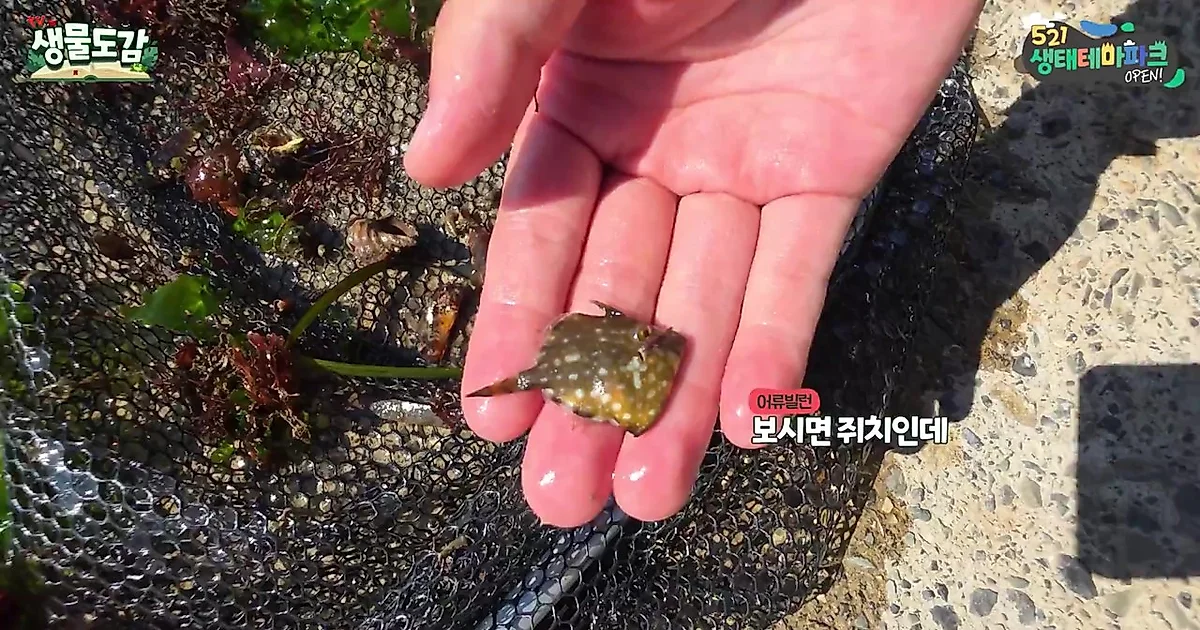
In addition to butterflyfish, the Bannerfish, which has a brilliant appearance, was discovered. Bannerfish travel to South Korea by riding warm currents during their juvenile stage, and they have the characteristic of becoming more agile and intelligent as they grow over time. Along with this, an individual presumed to be a yellow-colored boxfish was also found, drawing attention. Boxfish are characterized by having skin made of bony plates, making them hard like bone.
Furthermore, the new filefish, which is difficult to observe because it usually lives at depths of tens of meters or more, and the Chejibudo, a precious species that rarely appears in Jeju Island and the southern coast, were also collected. As subtropical fish species, they are serving as indicators showing the changes in the Korean seas. In addition, the Golden Filefish and the new filefish, which are among the filefish species, were observed.
Native Blennies and organisms with unique ecology
Among the tropical fish, the native Korean species, the Striped Blenny, was also identified. Unlike other blennies, the Striped Blenny has the characteristic of swimming slowly in the mid-to-upper layers rather than crawling along the bottom, making it known to have high ornamental value. In addition, the Scaly Blenny, which has crown-like protrusions on its head to threaten with its mouth or seduce females inside holes, and the Sea Spider, which moves very quickly in the water as if running, were captured in the video.
Meanwhile, extreme caution is required regarding contact with organisms when collecting in the sea during the summer. The participant in the video warned that if stung by a Medusa (jellyfish species), a serious allergic reaction can occur, such as the entire hand swelling, and if the symptoms are severe, it can be dangerous enough to require a visit to the emergency room. Since even a small individual can be very painful if stung, caution is necessary during collection.
Related Articles
Why Wild Birds Do Not Get Diabetes Despite High-Sugar Diets
Tropical fish captured off the coast of Ulsan, flowing into the East Sea via warm currents

Five households remaining along the 51km path of the Donggang River, living in remote villages connected by rope boats

Difference Between Mangrove Horseshoe Crabs and Venomous Species: How to Distinguish Them by Shape

Snapping Turtle Captured in Seoul's Hongjecheon Stream, Large Specimen Difficult to Lift with One Hand

5,000 Golden Mandarin Fish Released in Hwacheon, Gangwon, Starting Restoration of Natural Monument

Reservoirs Dried Up by Drought: Why Bullfrog Fishing Failed

65 Species of Native Creatures Found in Hongcheon Stream Gathered in a Mobile Aquarium

800 Mountain Goats Survive in DMZ Rocky Areas... Wild Ecosystem Blocked by Barbed Wire

The reason the moon looks larger is due to perigee and optical illusions

The 'Lek' of Birds Gathering Similar Males: Is it a Strategy Targeting Females' Decision Paralysis?

The Changes in Paldang Lake Fisherman Seong-ju and Gumchi, and the Spawning Grounds Lost to Sediment Inflow

Komodo dragon's hunting secret is venom glands and serrated teeth, not bacteria in saliva

Deep-sea creatures at Nagoya Aquarium: The characteristics of the 16cm Scaly-foot Snail where females parasitize males

Fish Survey in Wangsukcheon Stream Confirms Species Ranging from Mandarin Fish and Draco to Endangered Sira

The Monk of Mungyeong Bongamsa Temple's Cave: A Life Coexisting with Squirrels and Butterflies in a 40-Year-Old Rock Crevice
Estimated 20 Musk Deer at Haesanryeong Pass: A Record of the Wild Found Through Tracking Traces

Why Forest Walks in Germany Help Relieve Pain in the Elderly

How squirrels and flying squirrels recycle forest nests to raise their young

Comments 0