
The reason the moon looks larger is due to perigee and optical illusions
The phenomenon of the full moon appearing larger in autumn is caused by its proximity to Earth at perigee and visual optical illusions.
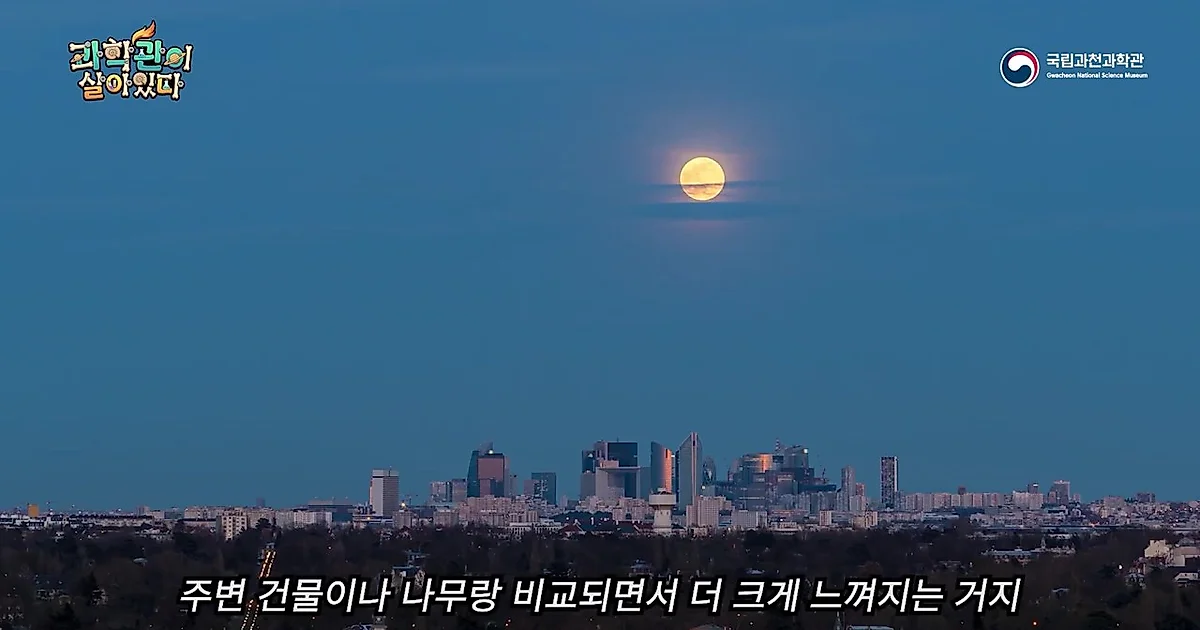
The phenomenon where the autumn full moon feels larger than usual is not because the moon has actually grown larger, but is related to its distance from Earth and visual optical illusions. According to a video from the National Gwacheon Science Museum, when a full moon rises at 'perigee', the point where the moon is closest to Earth, it is called a 'supermoon'. Because the moon's orbit is elliptical rather than a perfect circle, its size appears to change depending on its distance from Earth. Conversely, a moon that rises at 'apogee', the point where it is farthest from Earth, is referred to as a 'micromoon'.
The science behind supermoons, blue moons, and the color of the moon
Another reason the moon appears large is due to optical illusions. When the moon is located near the horizon, it can feel larger than it actually is when compared to surrounding buildings or trees. Names related to the color of the moon also contain scientific principles. When a full moon rises twice in one month, the second moon to rise is called a 'blue moon', which is not a phenomenon where the moon turns blue. Additionally, the 'blood moon', where the moon appears red during a total lunar eclipse, is a light scattering phenomenon that occurs because Earth's atmosphere scatters blue light and allows only red light to pass through to the moon.
The 'seas' on the lunar surface are traces of lava, not water
The dark areas observed on the lunar surface have been called 'seas' since the past, but they are not actually places filled with water. These are terrains created by lava erupted from past volcanic activity that solidified, and the name was given because their shapes resemble seas. Depending on the changes in the moon's phases, a process occurs leading from the crescent moon, first quarter moon, full moon, last quarter moon, to the waning crescent moon, and the moon does not emit light itself but appears bright by reflecting sunlight. Meanwhile, on Earth, only the same side of the moon can always be observed because the moon's orbital period around Earth matches its rotational period.



Comments 0