
Proposals for the National Folk Museum of Korea's Transition to a World Culture Museum: Emphasizing the Connection Between Museum Purpose and Visitors
A roundtable discussion was held at the National Folk Museum of Korea to discuss transitioning the institution into a world culture museum.
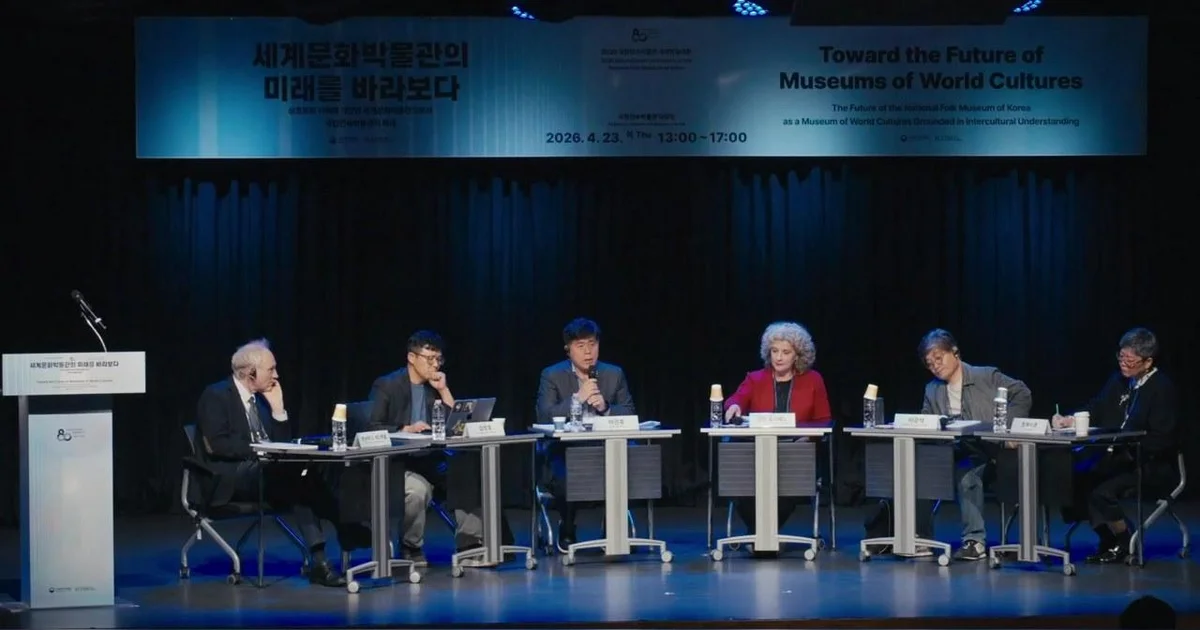
A roundtable discussion on proposals for the National Folk Museum of Korea's transition to a world culture museum system was held on April 23, 2026, at the main auditorium of the National Folk Museum of Korea. As the third session of the 2026 National Folk Museum of Korea International Conference themed "Looking into the Future of World Culture Museums," the session was moderated by Lee Gwan-ho, Vice Chairman of ICOM Korea. Five presenters who spoke on this day participated in the roundtable, which proceeded in an open Q&A format without designated debaters. Aisha Al Misnad, Deputy Director of Qatar Museums, who presented via video, expressed regret at not being able to participate in the roundtable and sent her thoughts via QR code.
Moderator asks what to prepare when expanding from folklore to world culture
Moderator Lee Gwan-ho introduced himself, stating he worked at the National Folk Museum of Korea for over 30 years until 2022. He summarized that museums in Europe, which were mainly named ethnological museums, are recently mostly changing their names to civilization museums or culture museums, and that the presenters spoke about future museums within this context. He then asked common questions: what is the most important keyword when expanding from the keyword "folklore" to the keyword "world culture" and how to prepare, and what is the new role of a world culture museum amidst rapidly changing social shifts. In particular, he asked what would be good to prepare and how in terms of convergence, noting that although the folk museum targets 2031, he feels urgent and that there is not much time.
From our own museum to the museum of others
The first presenter to respond focused on the process of the museum moving from a "museum of ourselves" to a "museum of others" in a different way. He stated that it is important for South Korea to not stop at just talking about other cultures, but to work together with people from each country, much like the aforementioned networks. He identified the task of balancing explaining content easily primarily to visitors in South Korea while creating discourses consulted with local people without forcing outside perspectives.
He explained that it depends on whether one works with people in the field of cultural diplomacy, museum professionals, or members of each country's community, as people can have different expectations and different understandings of their own culture. He noted that not only at the national level, but the diversity of world culture, understanding of the world, and forms of aesthetics and creativity are also different. He added that it is very important to learn not only from success stories but sometimes from mistakes or experiences that were not very successful. Moderator Lee Gwan-ho interpreted this remark as emphasizing the exchange at the level of networks and the museum of others, summarizing that the direction of the world culture museum should be set from a contextual, culturally relative standpoint.
Australian presenter emphasizes museum purpose and visitor trust
Presenter Bree Romsted from Australia said she felt the National Folk Museum of Korea has a very clear vision. She explained that when a museum tries to maintain relevance and move toward the future, it helps to return to the core questions: what is the purpose of the museum, what is delivered to which visitors, and how is it different from other museums.
She also said that museums receive a lot of trust from visitors, and research also shows that museums hold such a privileged position. She suggested that there is an opportunity to use this trust to take visitors along in a somewhat challenging way, and if the right conditions are created where visitors feel safe and supported, that opportunity can be seized. Moderator Lee Gwan-ho summarized this by saying that in future museums, moving beyond simple stages of exhibition, education, and collection, "for whom is the museum" is most important, emphasizing differentiation and trust.
Singapore National Museum establishes guiding principles through 3 years of stakeholder engagement
Following Bree Romsted's mention of asking about the museum's purpose, presenter Cheng Mei Koon explained, using the experience of the National Museum of Singapore, what should be done after the vision becomes clear. He said that upon starting the reorganization work to change everything about the Singapore History Gallery three years ago, they embarked on a three-year strategic plan for stakeholder engagement. He confessed that involving stakeholders in open sessions was honestly very difficult and complex.
However, his assessment is that looking back, it was very useful. He explained that through the participation sessions, they established several guiding principles that they have continued to refer to over the past three years, and they were able to review what stakeholders said and what was important to them. He pointed out that while a museum must be very clear about what it wants to achieve, it must also connect with visitors; otherwise, it returns to the traditional way of providing a one-sided experience without connection.
Moderator Lee Gwan-ho recalled that when he started as a curator in 1992, museum exhibitions were exhibitions meant to satisfy curators, but now participatory perspective exhibition methods are being discussed. He shared that when he visited the National Museum of Singapore on a family trip two years ago, he was impressed by the dedicated space for senior groups. He said that space had no exhibits and was a very comfortable space for seniors, adding that he thought South Korea should also take interest in this.
Comments 0