
From Buddha Statues Made of Onggi Clay to Black Glaze: Six Artists Reinterpret 'Tradition, Revisited'
The special exhibition "Tradition, Revisited," held as part of the Gyeonggi Ceramics Biennale 2026…
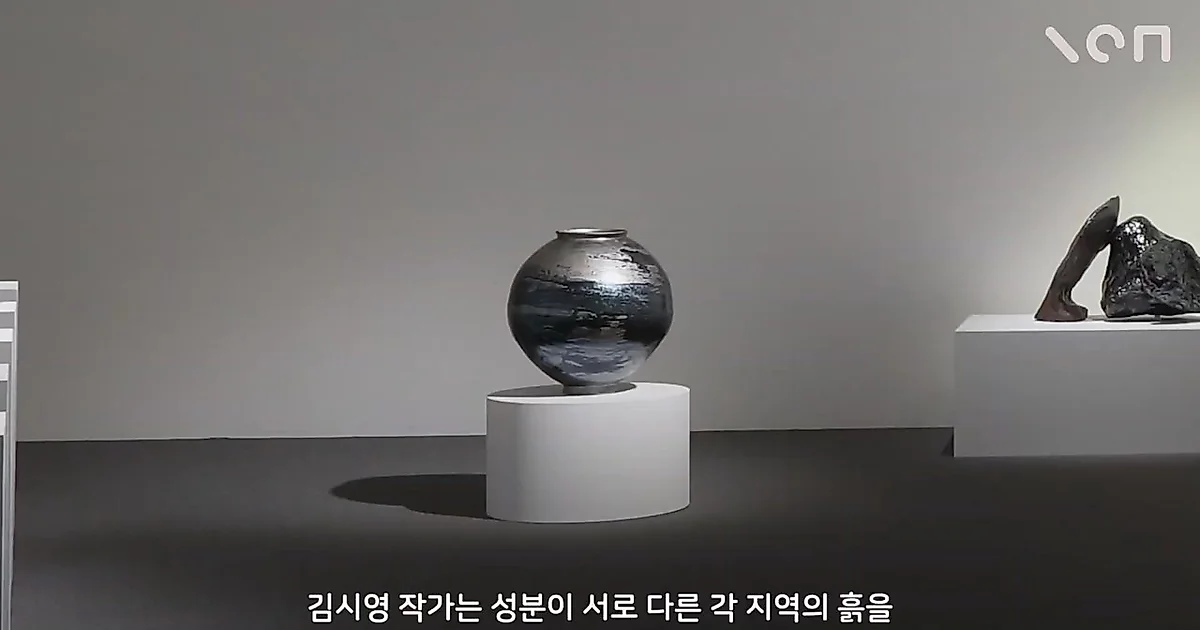
When people think of Korean ceramics, they often recall Goryeo celadon or Joseon white porcelain, but throughout our history, various ceramic forms have existed that did not receive much attention because they did not represent a specific era. The special exhibition 《Tradition, Revisited》, held as part of the Gyeonggi Ceramics Biennale 2026, presents new possibilities for Korean ceramics through six artists who reconstruct familiar traditions into unfamiliar forms.
Buddha Statues Made of Onggi Clay and Modern Reinterpretations of Earthenware
The exhibition begins with works that break the ceramic forms we are familiar with. Artist Jeong Yeong-rak presents entirely different forms using onggi clay, which is typically used to make jars. Among his works, which are shaped on a kick wheel using onggi clay mixed with iron and sand and fired in a wood-burning kiln, are small Buddha statues with a dark and coarse earthy color. This is the result of combining memories of Buddha-nature heard from his grandfather during his childhood with onggi clay, which he has worked with for over 30 years.
Artist Kim Ho-jeong, who studied at the Royal College of Art, works inspired by Bisalmun earthenware from thousands of years ago. However, instead of reproducing the appearance of ancient earthenware exactly, she chooses methods such as mixing different clays and colors or making clay into plates and joining them together. Through this, she creates unique results that combine traditional forms with modern colors, ranging from small, round vessels to elongated cylindrical shapes.
The Colors of Black Glaze Created by Regional Clay Composition and the Brushstrokes of Buncheong
Artist Kim Si-young, who explores the depth of black ceramics, presents diverse black glazes, earning him the title 'Alchemist of Flames.' Although they may all appear black, the reason each work has a different color is due to the different compositions of the clay the artist uses. Clay brought from different regions undergoes different chemical reactions when meeting fire inside a high-temperature kiln, creating subtle color differences ranging from deep black to brown and reddish hues.
The methods used by artists showing the charm of Buncheong ware also differ. Artist Lee Su-jong, who has worked on iron-painted Buncheong for over 50 years, paints designs on ceramics coated with white clay using iron-based pigments. Rather than repeating fixed patterns, he creates scenes like a single painting on the ceramic surface through methods such as leaving strong black brushstrokes or leaving wide empty spaces. On the other hand, the young ceramic artist Jeong Yeong-yu, born in 1992, uses the 'Guihal' method involving coarse brushes. Depending on the speed and strength of the brush, the white clay is left thickly or the black color is revealed, capturing the movements of nature like a rock eroded by wind and rain.
A World of Diverse Forms Implemented through Variations of the Wheel
Artist Lee In-jin shows how diverse the forms (shape) of ceramics can be, having continued wheel-based work for nearly 50 years. This is because the height, width, and proportion change completely depending on the fine control of hand strength and movement on the wheel. The artist demonstrates the scalability of wheel work by presenting a variety of shapes that go beyond the categories of bottles or jars we commonly know, from small, high-rising forms to low, widely spreading forms.
This special exhibition is organized so that the artistic worlds of each artist can be examined in depth in independent spaces. The exhibition is held in two locations: the Gyeonggi Museum of Contemporary Ceramic Art in Yeoju and a Hanok gallery, Gallery Jiuhun, in Bukchon, Seoul. Visitors can compare and appreciate how the works of the same artist approach them differently through the difference in the sense of space of the museum and the atmosphere provided by the Hanok space.
[Exhibition Information]
■ Exhibition Name: Gyeonggi Ceramics Biennale 2026 Special Exhibition 《Tradition, Revisited》
■ Participating Artists: Kim Si-young, Kim Ho-jeong, Lee Su-jong, Lee In-jin, Jeong Yeong-rak, Jeong Yeong-yu
■ Exhibition Venue and Period:
- Gyeonggi Museum of Contemporary Ceramic Art: Friday, September 18, 2026 ~ Sunday, November 1, 2026
- Gallery Jiuhun: Wednesday, September 16, 2026 ~ Saturday, October 17, 2026

Comments 0