
10 Penalty Points for Failure to Use Turn Signals or Seatbelts... Intensive Traffic Law Enforcement to Begin in October
Intensive enforcement against major traffic violations is scheduled to begin in October…
As the scale of fines and penalties for traffic law violations has already exceeded 850 billion won as of July this year, intensive enforcement against vehicles violating major traffic laws is announced to begin this October, requiring caution from drivers. With fines and penalties imposed for traffic violations exceeding 1.3 trillion won last year alone, this enforcement includes items that can lead to license suspension due to accumulated penalty points, going beyond simple fines.
Push for 10 Penalty Points for Failure to Use Turn Signals and Failure to Wear Seatbelts
According to a Beomissem video, regulations regarding the failure to use turn signals (blinkers), which is one of the most frequent violations by drivers, will be strengthened. According to statistics mentioned in the video, it is an item that causes frequent confusion, with 7 out of 10 drivers picking it as a wrong answer. In the past, failure to use turn signals was often handled with warnings rather than strict enforcement, but in the future, 10 penalty points may be immediately imposed along with a fine during enforcement. In particular, since penalty points are calculated cumulatively over one year, a driver could face immediate license suspension if caught four times within a year for failing to use turn signals. However, these regulations are scheduled to be applied in stages starting from October.
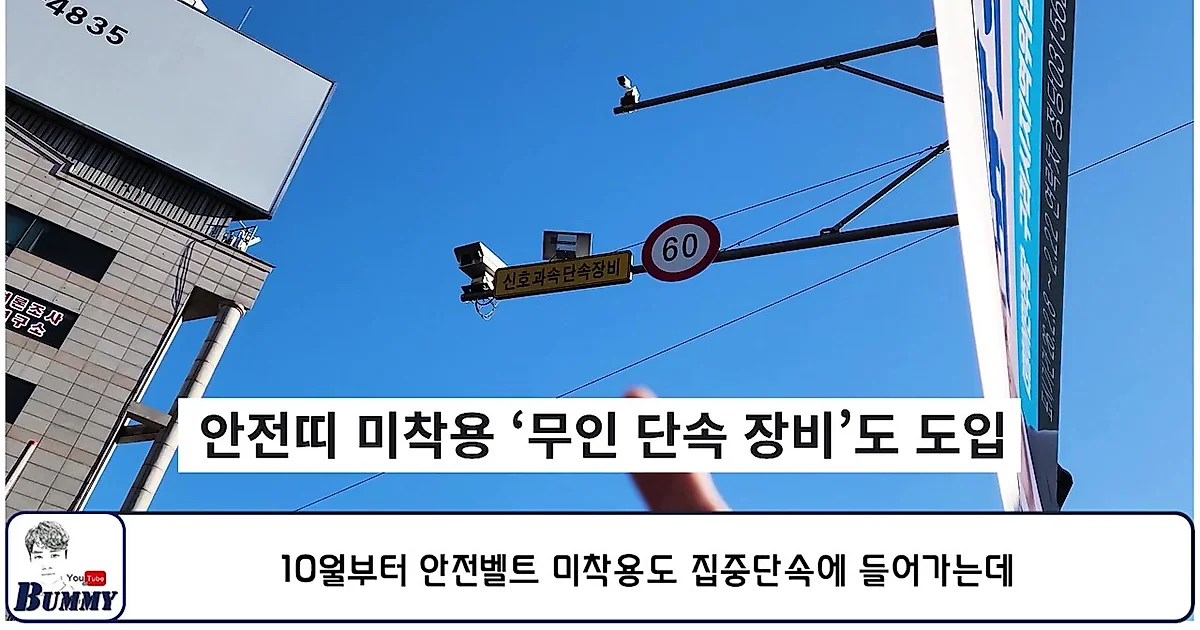
Whether seatbelts are worn is also a target for intensive enforcement. The enforcement methods are also expected to become more advanced. Unmanned enforcement equipment is expected to be introduced, where the police photograph the front of the vehicle to check not only the driver's seat but also whether the passenger's seatbelt is worn. Some suggest the possibility of multi-dimensional enforcement using drones equipped with AI video analysis and automatic tracking functions. While drone enforcement cameras have mainly been used on highways, the scope of enforcement may expand through advanced AI technology. As a plan to impose 10 penalty points for failure to wear a seatbelt is also being pushed, caution is required for both front and rear seats.
Mandatory Installation of Alcohol Prevention Devices for Habitual Drunk Drivers
Strong measures to prevent recidivism in drunk driving will also be implemented. From October, drivers caught for drunk driving two or more times within the last five years must install an 'alcohol prevention device' in their vehicles. This device checks the alcohol concentration by having the user blow into a tester before starting the engine; if any alcohol has been consumed, the engine itself will not start. Furthermore, to check for alcohol consumption intermittently during driving, the user must blow into the device, and if alcohol is detected, the engine will be immediately cut off.
The period for device installation is up to five years, and the cost of purchase and installation must be borne by the driver. If this is not implemented, separate penalties will follow. In addition, strong regulatory measures are being discussed, such as a plan to cause social shame by replacing the license plates of habitual drunk drivers with special red license plates, or a bill to disclose personal information such as names and faces if a driver who caused a fatal accident through drunk driving is caught two or more times within 10 years.
Rear Enforcement for Two-Wheelers and Electric Scooters and Utilization of Good Driver Mileage Program
Enforcement against two-wheelers and electric scooters will also be strengthened. Rear-facing enforcement cameras, which are being installed more frequently recently, use AI systems and radar to enforce not only two-wheelers but also four-wheeled vehicles. Previously, they were mainly installed on backroads in residential areas, school zones, and single roads, but recently they are often seen at intersections with heavy vehicle traffic. In particular, caution is needed as two-wheeler riders may be imposed 10 penalty points each if they do not wear a helmet or turn on their turn signals.
Meanwhile, to prevent license suspension due to sudden accumulation of penalty points, it is recommended to utilize the 'Good Driver Mileage Program'. This system, which can be applied for through the Korean National Police Agency traffic complaint website, allows the mileage accumulated by maintaining a record of no accidents and no violations to be used to offset penalty points that occur during future enforcement. Even for those with "closet licenses" (inactive licenses), it is useful to apply in advance for the future, and it takes effect immediately upon application.



Comments 0