
Flatworms Sent into Space Reveal Surprising Insights into Human Space Travel
A flatworm sent to the ISS developed two heads. When it divided, the resulting flatworms also had two heads, suggesting the trait might persist.
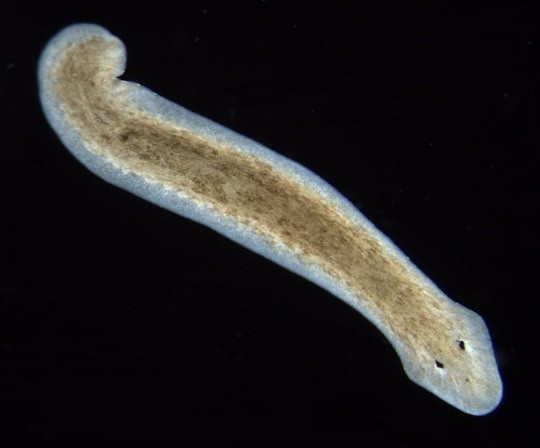
[FamTimes reporter Park Ju-hye] A flatworm that took part in a space experiment returned as a two-headed animal.
Space scientists sent flatworms to the International Space Station (ISS) to observe the physical changes caused by space travel.
Chris Kimmel, founder of the Kentucky Space Center, explained that although there have been many studies on physical changes in astronauts, very few have demonstrated that weightlessness affects the body at the molecular or cellular level.
Scientists say it is important to study how Earth's gravity and magnetic field affect cells' decisions to divide, the differentiation of individual organs, and when growth stops, regardless of species.
To investigate this, scientists sent both intact and partially severed flatworms into space in 2015 and observed the changes.
Flatworms are well known for their ability to regenerate after being cut, and the specimens were kept in containers filled half with air and half with water. A control group was also tested on Earth under the same environmental conditions.
When the experimental group sent into space returned to Earth, the researchers made a surprising discovery: one of the specimens had developed two heads.
When that flatworm divided, the resulting flatworms also had two heads, leading the researchers to predict that the two-headed trait would persist for a long time.
Michael Levin, a biologist at Tufts University, said, “Seeing a two-headed flatworm is very mysterious.”
Another experimental specimen, an intact flatworm, developed into a naturally shaped individual.
The researchers acknowledged several limitations in the study. They could not determine how temperatures in space affected the specimens because the control group on Earth could not be kept at exactly the same temperatures as those in space.
No additional cutting or experiments were conducted before the flatworms returned to Earth.
Levin said he hoped that scientists aboard the International Space Station in the future would cut flatworms in space and report the changes they observed.
The findings were published in the journal Regeneration.
Reporter Park Ju-hye fam1@pcss.co.kr
FAM타임스 명의로 발행된 기사를 모아 제공하는 매체 공용 저자 페이지입니다.

Comments 0