
World’s First 100-Million-Year-Old Lizard Footprint Fossil Found in Namhae
A 100-million-year-old lizard footprint fossil found in Namhae was confirmed as the world’s first known Cretaceous example.
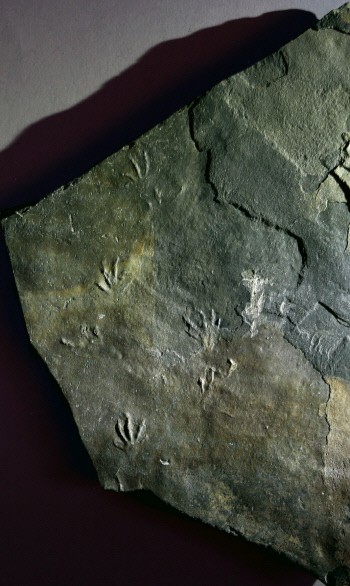
[Dog Newspaper=Reporter Han Jeong-a] A lizard footprint fossil from the Cretaceous Period of the Mesozoic Era has been discovered in Korea, the first such find in the world.
On the 8th, the National Research Institute of Cultural Heritage under Korea’s Cultural Heritage Administration announced that a team of researchers from four countries—Korea, the United States, Spain and China—had analyzed the fossil, which was found at the Gain-ri Fossil Site in Namhae, South Gyeongsang Province (Natural Monument No. 499), and confirmed it as the world’s first known lizard footprint fossil from the Cretaceous Period of the Mesozoic Era.
The lizard that left the footprints was identified as a new species and named “Neosauroides koreaensis,” meaning “a new type of lizard discovered in Korea.”
The fossil was found in the Haman Formation, a sedimentary layer deposited in the Gyeongsang region around 100 million years ago. Footprint fossils from various animals, including dinosaurs, pterosaurs and birds, have previously been discovered in the formation.
Worldwide, the only previously known Mesozoic lizard footprint fossils were those of the Triassic genus “Rhynchosauroides.”
The Namhae lizard footprint fossil was discovered in February 2013 during a geological field trip by the Earth Science Teachers’ Research Association, led by Professor Kim Kyung-soo of Chinju National University of Education. It bears eight forefoot prints and one hindfoot print.
An official said, “Cretaceous lizard footprint fossils from the Mesozoic Era are believed to be rare because, after the Jurassic Period, lizards moved from coastal areas and lakeshores to inland habitats,” adding, “About 100 million years ago, Gain-ri in Namhae lay on the shore of a large lake.”
The official added, “The discovery of the lizard footprint fossil once again proves that a wide variety of vertebrates lived in Korea during the Cretaceous Period of the Mesozoic Era,” and said, “The fossil is scheduled to go on public display at the Natural Heritage Center exhibition hall of the National Research Institute of Cultural Heritage in the first half of next year.”
The findings from the study of the Namhae lizard footprint fossil were published in the August 26 online edition of Cretaceous Research, a journal indexed in the Science Citation Index (SCI).
Reporter Han Jeong-a han@dognews.co.kr
FAM타임스 명의로 발행된 기사를 모아 제공하는 매체 공용 저자 페이지입니다.


Comments 0