
New Lizard Species Identified 150 Years After Dinosaur Fossil’s Discovery
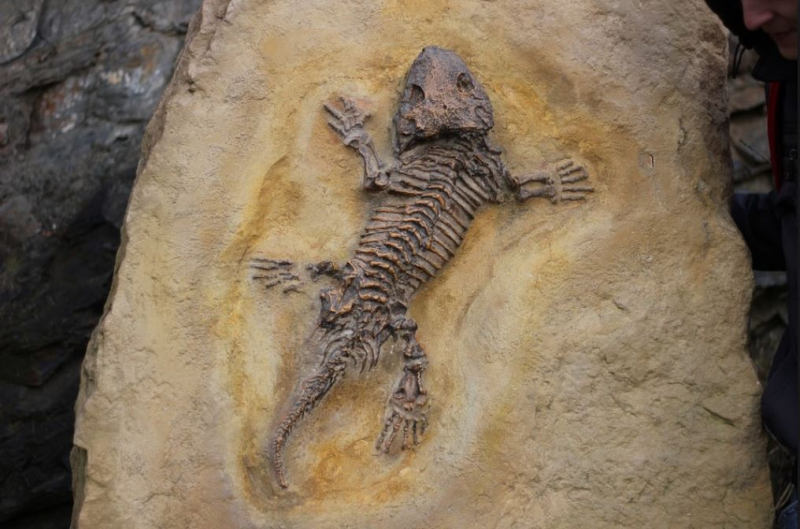
A lizard found in a Compsognathus fossil’s stomach was identified 150 years later as the new species Schoenesmahl dyspepsia.
 ▲ Source: Pixabay
A new lizard species has been identified in a carnivorous dinosaur fossil discovered by Dr. Joseph Oberndorfer in 1859, about 150 years ago. Scientists could not hide their astonishment at the discovery after 150 years.
The lizard, probably the fossilized dinosaur’s last meal, was initially believed to be Bavarisaurus macrodactylus, a lizard species that lived in what is now Germany during the Late Jurassic.
However, Dr. Jack Conrad of the American Museum of Natural History said his research showed that the lizard belonged to an entirely different, new species. The new species was named Schoenesmahl dyspepsia, which translates as “a good meal that is difficult to digest.”
The lizard was found inside the stomach of a dinosaur called Compsognathus. In other words, it was the last animal the dinosaur ate before it died.
Unlike the Bavarisaurus that scientists initially thought it was, the lizard had a bone that Bavarisaurus lacks, ultimately leading scientists to conclude that it was a new species.
Describing the lizard identified as a new species, Conrad said, “This is a complete holotype with scales. It has a posteroventral process of the jugal, lacks a frontoparietal suture, and its mandibular process gradually broadens.”
He added that after comparing and analyzing the lizard alongside 220 reptile species, he concluded that it was an entirely new species.
FAM타임스 명의로 발행된 기사를 모아 제공하는 매체 공용 저자 페이지입니다.


Comments 0