
The Crested Pigeon's Wingbeats Warn of Danger
Crested pigeons use high-frequency wingbeat sounds from a narrow eighth primary feather to warn other crested pigeons of danger.
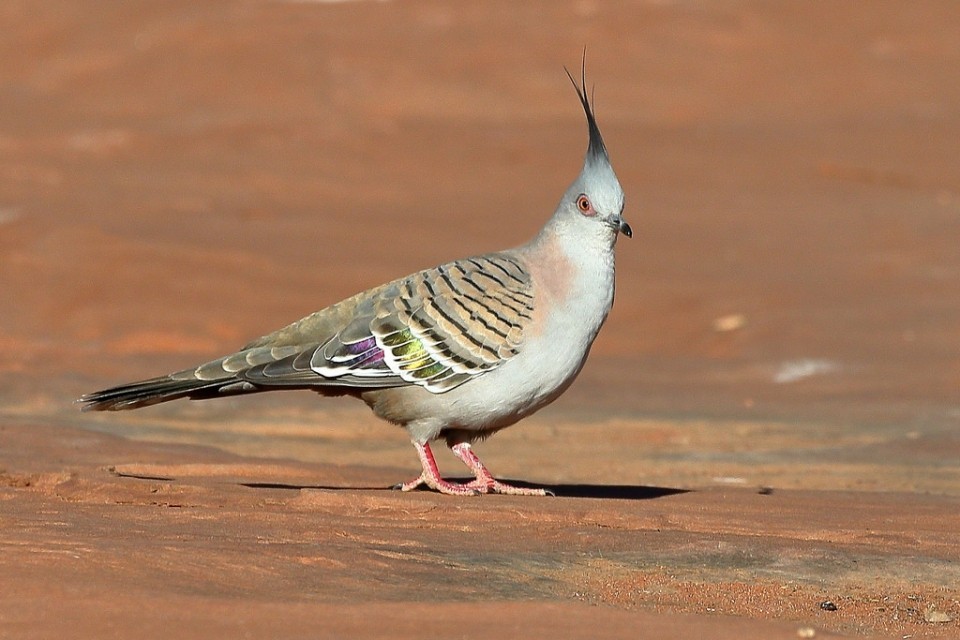
Some animals make calls or high-frequency sounds to warn their companions of approaching danger. But one bird behaves unusually when it senses danger.
As early as 150 years ago, the renowned Charles Darwin suggested that some bird species might use “non-vocal means.” Until recently, however, no evidence had been found to support Darwin's idea.
Trevor Murray of the Australian National University said that when crested pigeons detect danger, they produce loud wingbeats instead of making calls.
Experts already knew that crested pigeons—also nicknamed “whistling-winged pigeons”—produce loud sounds with their wings when taking flight. Recently, however, other crested pigeons were observed fleeing after hearing the loud wingbeats, prompting the suggestion that the sound may serve as a signal rather than merely being a noise pigeons make in flight.
The study found that the crested pigeon's eighth primary wing feather has a uniquely narrow shape and produces a high-frequency sound as the bird beats its wings. Crested pigeons can produce both high- and low-frequency sounds in flight. As their wingbeats accelerate, the frequency of the sound rises, serving as an alarm that warns other crested pigeons of approaching danger.
After conducting several experiments, Murray concluded that the crested pigeon's distinctive wingbeats are inherently a highly reliable alarm signal. A pigeon encountering a predator must beat its wings faster, and the sound produced by those faster wingbeats naturally becomes higher in frequency.
The researchers plan to continue studying the evolution of wingbeat sounds in other birds, including other pigeon species, hummingbirds and manakins.
FAM타임스 명의로 발행된 기사를 모아 제공하는 매체 공용 저자 페이지입니다.



Comments 0