
The Secret of a Fish That Can Fly Without Wings
The ribbon halfbeak flies by rotating its body 90 degrees, offering scientists insights that could improve understanding of aircraft flight.
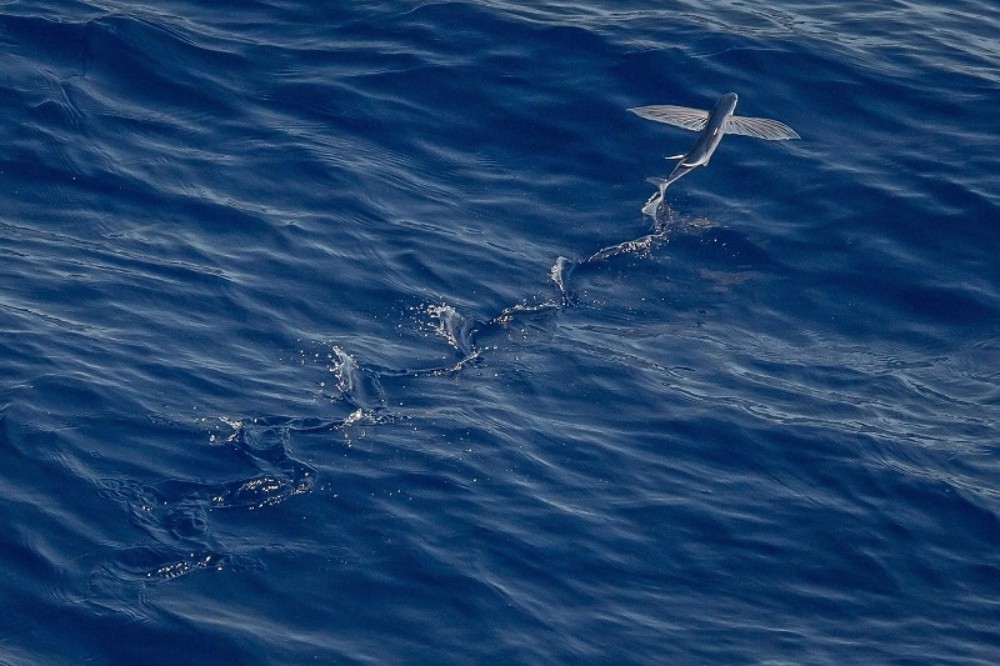
[FamTimes reporter Kang Gyu-jeong] The ribbon halfbeak, a type of flying fish, can fly without needing wings. It does not use the tail fins and other features employed by other flying fish. Instead, the ribbon halfbeak moves by rotating its body 90 degrees.
Recent research presented at the Society for Experimental Biology Annual Meeting reveals the science behind how the ribbon halfbeak flies.
Dr. Yoshinobu Inada of Tokai University said, “Other flying fish, including the Japanese flying fish, have large pectoral fins that act as wings and large tail fins used like an airplane’s horizontal stabilizers.”
Dr. Inada explained, “But the ribbon halfbeak does not have these large tail fins. It solves this problem by rotating the rear of its body 90 degrees and using its broad fins and tail like horizontal stabilizers.”
Inada described the ribbon halfbeak’s flying technique as very clever. To gain better buoyancy and air for flight, the ribbon halfbeak must twist its body to a particular angle, as Inada explained. Most other flying fish do not have this need.
Junji Yonezawa of the Tokyo Metropolitan Islands Area Research and Development Center for Agriculture, Forestry and Fisheries, one of the study’s co-researchers, discussed why the ribbon halfbeak’s unique characteristics are so special.
Yonezawa said that, compared with most flying fish, the ribbon halfbeak demonstrated its evolutionary capabilities as it encountered different situations and environments. The ribbon halfbeak has the greatest number of vertebrae.
Scientists hope to apply insights from research into the ribbon halfbeak’s flight to further improve and understand aircraft flight.
Reporter Kang Gyu-jeong fam7@pcss.co.kr
FAM타임스 명의로 발행된 기사를 모아 제공하는 매체 공용 저자 페이지입니다.



Comments 0