
Anmyeondo Baeksajang Port Jumbo Shrimp Festival: How to Enjoy It 5,000 Won Cheaper Than Namdang Port
This article provides tips on visiting the jumbo shrimp festival at Baeksajang Port in Anmyeondo…

If you plan to visit the jumbo shrimp festival held at Baeksajang Port in Anmyeondo, Chungnam, it is important to check the festival period and price range in advance, as they differ from Namdang Port. According to the Ipjil-ui Chueok TV jiminTV video, the Anmyeondo Baeksajang Port festival is short, running until September 19, but even after the festival ends, shrimp can be purchased through the market or via delivery. As autumn deepens, the size of wild jumbo shrimp increases, but it should be noted that price fluctuations can occur daily accordingly.
Price Differences and Characteristics of Baeksajang Port and Namdang Port
The Anmyeondo Baeksajang Port seafood market forms a relatively cheaper price range compared to the nearby Namdang Port. Comparing the prices based on 2026 as seen in the video, while whiteleg shrimp at Namdang Port are around 40,000 won per 1kg, Baeksajang Port is around 35,000 won, which is about 5,000 won cheaper. At both locations, if you purchase seafood from the market and have it grilled at a nearby restaurant, an additional cost of 20,000 won per 1kg is incurred, including basic side dishes and grilling fees. For example, if you buy 1kg of jumbo shrimp at Baeksajang Port for 35,000 won and add the 20,000 won restaurant usage fee, the total cost will be 55,000 won.
Inside the seafood market, you may see the label 'farmed jumbo shrimp,' which often actually refers to farmed 'whiteleg shrimp.' The video mentions that there are cases where even live farmed whiteleg shrimp are labeled and sold as jumbo shrimp, and such labeling methods, which can cause consumer confusion, should be avoided. When choosing wild jumbo shrimp, it is good to check if black lines appear on the body. Jumbo shrimp can develop black lines over time, so in such cases, it is necessary to be cautious when purchasing.
Differences in Taste and Texture Between Wild Jumbo Shrimp and Whiteleg Shrimp
Wild jumbo shrimp and farmed whiteleg shrimp show distinct differences in taste and texture. Farmed whiteleg shrimp are characterized by having a very bouncy meat texture when eaten alive, providing an excellent chewing experience. On the other hand, wild jumbo shrimp are evaluated to have a deeper and richer taste, although the texture may be relatively less bouncy. The participant in the video stated that they chose dead wild jumbo shrimp for the taste, even if it meant sacrificing freshness and the bouncy texture slightly.
There is also a difference in how to eat shrimp. The larger the shrimp, the more it is recommended to peel the shell and eat it. Eating with the shell on can be a matter of personal preference, but if you dislike the tough texture of the shell or find it uncomfortable to have bits stuck in your mouth, using plastic gloves to peel the shell and eat it makes enjoying the taste much easier.
How to Check Tides to Buy Blue Crab and Jumbo Shrimp Cheaply
If you want to purchase blue crab or wild jumbo shrimp more cheaply, you should aim for days when the catch volume is high. To do this, it is helpful to use the 'Sea Time' website to check the tides. You can set the region to 'Boryeong' and then check the tides; the period between the 6th and 11th tide (Sari water level), when the difference between high and low tide is large, is when the catch volume increases. When checking the tide notations, you can exclude 'Musi'.
The Sari period usually coincides with the time when a full moon or new moon rises, and a rough judgment can also be made by looking at the shape of the moon. Conversely, as it moves toward the 'Jogeum' period when the difference between high and low tide is small, a first quarter moon or last quarter moon will rise. By visiting in time with the period of high catch volume, you can expect the effect of prices dropping as the supply becomes abundant.
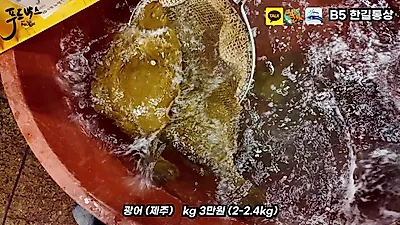
Meanwhile, in the case of rockfish, which can be purchased together at the seafood market, the yield (the amount of meat) is relatively low at around 28–30% because the head is large, but it is considered one of the preferred types of sashimi among Koreans due to its unique chewy texture and sweetness. The video also mentioned that there is high demand for enjoying spicy fish stew (maeuntang) when purchasing rockfish.

Comments 0