
BYD Sea Lion 08 priced in the 40 million won range in China... Air suspension and rear-wheel steering come as standard
The YouTube channel 'Kim Han-yong's MOCAR' analyzed recent Chinese SUVs, including the BYD Sea Lion 08, Xiaomi Skynomad N70 and N90, and XPeng GX…
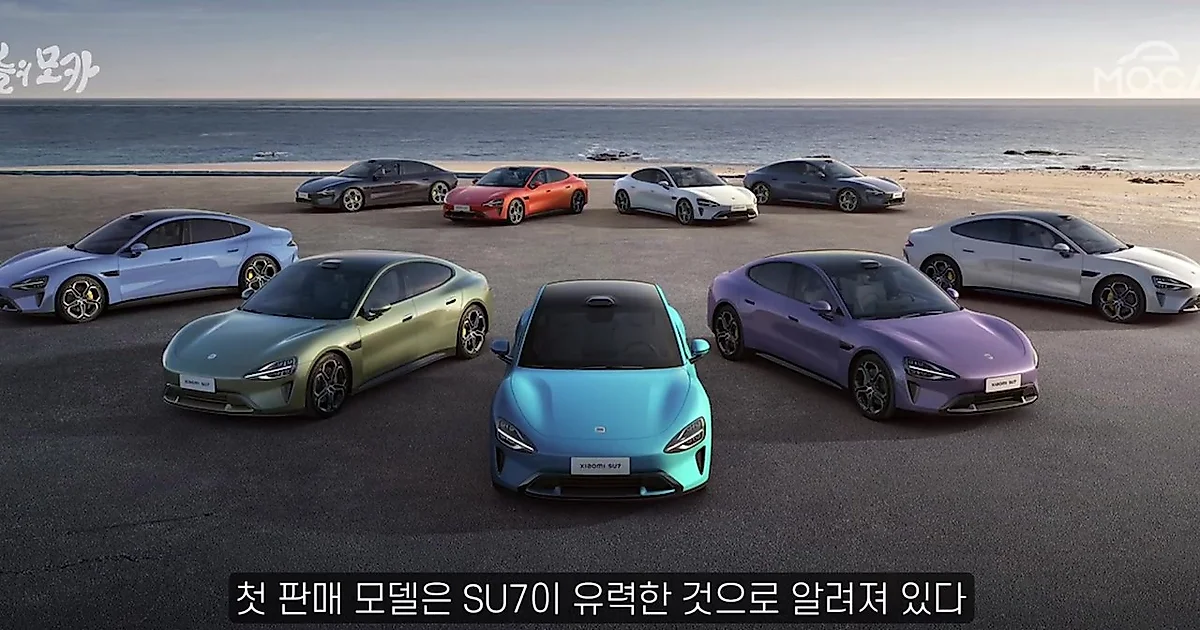
The YouTube channel 'Kim Han-yong's MOCAR' recently examined Chinese SUVs released within the last three months. According to the video description, it covered the design, interior space, convenience features, and local Chinese prices of the BYD Sea Lion 08, Xiaomi Skynomad N70 and N90, and XPeng GX. The prices converted to Korean Won in the video are based on local Chinese selling prices and are not the confirmed selling prices in South Korea; driving range and charging performance are also based on manufacturer announcements and specific test conditions.
BYD and ZEEKR sales increase... A void remains for Sorento-class electric SUVs
The video first pointed out that Chinese cars are unexpectedly selling in massive quantities in South Korea. Currently, the Chinese brands selling properly are BYD and ZEEKR, with ZEEKR reportedly exceeding 1,500 pre-orders. BYD has sold 23,630 units within 1 year and 6 months of its launch in South Korea. The video explained that BYD is the fastest-growing brand among imported brands launched in South Korea, noting that even when Tesla first entered the market, it did not sell to this extent.
The video pointed out that while the best-selling car classes in South Korea are currently the Sorento and Santa Fe, there are no suitable electric vehicles in that class among either domestic or imported cars. Among domestic cars, only very large vehicles like the IONIQ 9 or EV9 have three rows. The video explained that the reason manufacturers do not release electric vehicles in that class for fear of losing sales to the Sorento or Santa Fe is commonly called "cannibalization," and argued that in an era where it is no longer just Hyundai Motor Company and Kia dominating the market, they cannot continue in that manner. In China, mid-to-large sized 6-seater and 7-seater electric SUVs are being released one after another, and these vehicles, which possess product competitiveness, features, and low prices, are being weighed for potential release in South Korea. The video added that while manufacturers might feel this is a crisis, consumers might think about giving them a try.
BYD Sea Lion 08, a large SUV 55mm longer than the IONIQ 9
The first car is the BYD Sea Lion 08. The video introduced this as a car with a very high possibility of appearing in South Korea soon. Unlike existing BYD cars that applied curves and decorations to every surface, the exterior is treated smoothly without much artifice, giving it a decent and dignified feel. The video evaluated that while Chinese consumers might find it boring, it is a design that Europe or overseas markets would like, and a design that would also be liked in the South Korean market.
The body has a length of 5,115mm and a width of 1,999mm. It is about 170mm shorter than the Genesis GV90, but its length is 55mm longer than the IONIQ 9. The interior is decorated simply with a horizontal feel, and the center display is 17.3 inches. The video explained that since the GRANDEUR, which uses the largest display in South Korea, is 17 inches, this is slightly larger. There is a 6-seater model with captain seats in the second row and a 5-seater model with a bench seat.
Electric version reaches 900km CLTC, PHEV reaches 400km on electric mode alone
The Sea Lion 08 comes in both an electric vehicle (EV) and a plug-in hybrid (PHEV) version. The EV version is equipped with a 115kWh battery and is said to travel 900km based on the CLTC standard. The video noted that since CLTC numbers come out higher than the South Korean standard, one should subtract at least 30%, but even so, it seems it would comfortably exceed 600km. The all-wheel-drive model adds a motor to the front wheels, making the acceleration time to 100km/h about 2 seconds faster, from 5.9 seconds to 3.9 seconds. BYD claims that with its newly developed 1,000-volt charger 'Flash Charge,' it can charge from 10% to 97% in 9 minutes, and even at -30 degrees Celsius, it can reach 20% to 97% in 12 minutes.
The PHEV version adds an electric motor to a 1.5-liter turbo gasoline engine, and a 55.8kWh battery is installed. The video explained that since the Tesla Model Y uses a 60kWh battery, this is almost at a comparable level to an electric vehicle battery. The distance that can be driven using only electric mode without ever operating the engine is 400km based on CLTC, and the video estimated it would be around 280km when it comes to South Korea.
Air suspension, rear-wheel steering, and LiDAR are standard; options are only for those with specific preferences
The local Chinese price is 46 million won for the PHEV and 48 million won for the EV. The video emphasized that the standard options are tremendous. For the EV model, the 115kWh 2nd generation Blade battery is included in all trims starting from the base trim, and air suspension, a rear-wheel steering system, an autonomous driving system equipped with LiDAR called 'God's Eye', a Devialet audio system, a glass roof sunshade, and a 17.3-inch center display are all standard. Options are limited to things with polarizing preferences, such as adding 3 more speakers, a 3rd-row electric seat, rear seat configurations, HUD, and Nappa leather seats.
The video explained that as options increase, service centers must hold two types of parts, and logistics costs and testing burdens also increase, so they included all specifications that anyone might want. It added that rather than fragmenting specifications, it would be better for domestic car companies to include everything and lower the price slightly. The full-option price for the EV with all convenience features added to the all-wheel-drive model is 279,900 yuan, which is 56 million won at the local exchange rate.
The price may become more expensive when it enters South Korea. Citing the fact that the Sea Lion 7 is about 12% more expensive in South Korea than in China for the same model, the video estimated that if such an assumption is made, the 6-seater AWD model would be around 62.7 million won, meaning it could most likely be purchased in the 60 million won range. Even for BYD, which currently has no subsidies, it was evaluated that if it comes out at 60 million won, it would be equivalent to buying a large SUV at the price of a Model Y AWD, giving it destructive power.
Xiaomi Skynomad N90, length is exactly 5,285mm, the same as the GV90
The second is Xiaomi. According to the video, Xiaomi released the SU7 and YU7, which gained explosive popularity, and as the supply—which reportedly required a 2-year wait upon ordering—has become sufficient and demand has somewhat decreased, they are moving to export these cars overseas. The third vehicle released by Xiaomi is the Skynomad, which is used like a separate brand. Unlike previous Xiaomi cars which were unconditionally electric vehicles, the powertrain uses a method of driving an electric motor through power generation using an engine, and the video explained that the design, performance, and consumer base are completely different from existing Xiaomi cars, so they do not cannibalize each other.
The video explained that Skynomad is a family-oriented large SUV, and because it targets high-level corporate executives, etc., the age group appears much higher. In some respects, the design brings to mind a Range Rover, and in others, ZEEKR. There are two main models. The short N70 is a 5-seater with a length of 4,960mm, which is longer than the Santa Fe but slightly shorter than the Palisade. The long N90 is a 7-seater with a length of 5,285mm, and this length is exactly the same as the Genesis GV90 down to the millimeter. The video remarked that one might wonder if they intended to say it is a car similar to the GV90.



Comments 0