
They said they were pacifists... Baby capybara Boing monopolizes the meal with force
A video from SBS TV Animal Farm x Animalbwa shows baby capybaras Boing, Bo-ong, Boppo, and Boppi struggling to adapt to life in Korea…
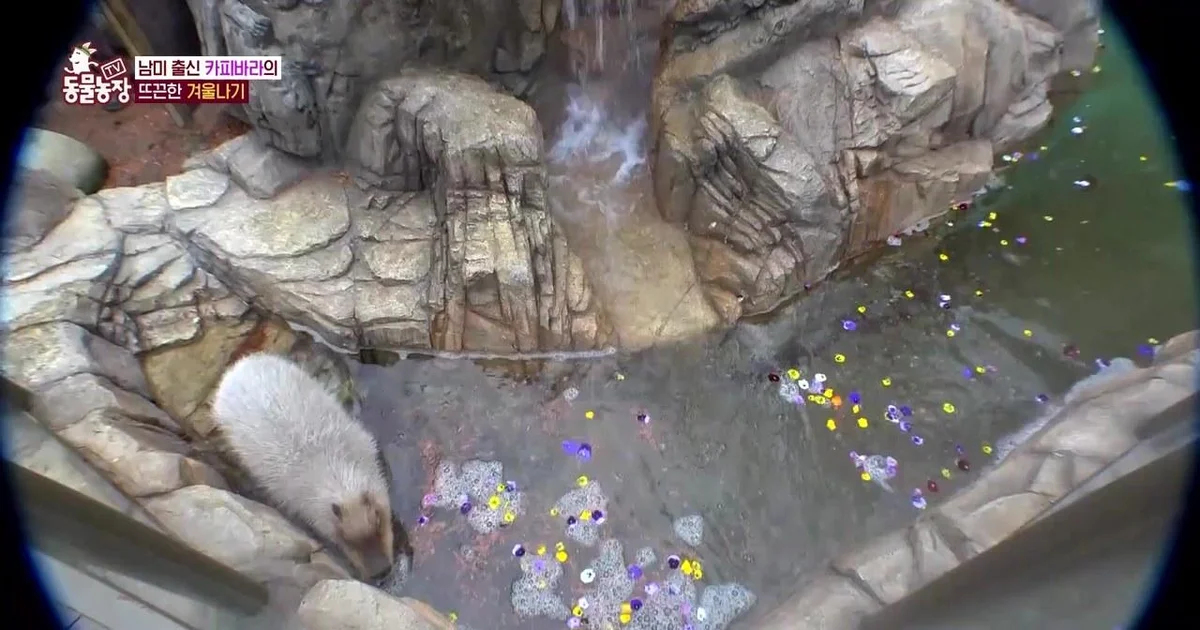
The capybara, famous for being the largest rodent on Earth, enjoys high popularity not only for its unique visuals but also for its characteristic personality. Famous for its sociable nature, with "friendliness" being a common associated search term, it has even earned the nickname "the pacifist of the animal kingdom" as it has been shown forming friendships across species with any animal.
In a video released by the SBS TV Animal Farm x Animalbwa channel, specifically the 982nd episode of TV Animal Farm titled "Introducing the Capybaras," the appearance of the baby capybaras is captured, which is quite different from this reputation.
The capybaras in the zoo in the video loved people enough to follow the keepers around closely, even though they had never been separately trained. It is said that they prefer being massaged over eating, and they have a characteristic where their fur stands on end when they feel good. While munching on food, if a keeper raised their hand, they would stop eating and wait quietly for a touch, and they would even fall asleep while receiving a massage.
One month after arriving in Korea, the baby capybaras fight over meals
In another enclosure, there were newly arrived baby capybaras. Boing, Bo-ong, Boppo, and Boppi, who are about 6 months old, have been in Korea from overseas for just one month. As they are still adjusting to the local environment, they were living separated from the existing capybara herd for their own safety. Capybaras are known to have very strong appetites, and among rodents, they are said to eat the most, consuming up to 4kg per day.
However, when the keeper set out the food, one of them suddenly threw a tantrum, drove away its friends, and monopolized the meal alone. It was Boing, who was larger in size than the other friends. Boing used its large size to drive away the friends and monopolized the food, and when the keeper distributed the food separately, Boing once again took the largest meal. The remaining babies also engaged in a chase while fighting at the mealtime, and one baby hid in fear before receiving the food brought by the keeper.
Regarding why the babies fight like this, an explanation was given that it is because only young individuals are being brought to the country. Usually, they should learn through imitative learning from parent individuals, but they have not learned enough yet. It is said that after they undergo the socialization process like the senior capybaras, they will be able to acquire the order and rules essential for herd life and live together harmoniously.
Food hung high, the first cooperation of stepping on each other's backs
Following the appearance of the seniors, who are good swimmers and can dive for up to 5 minutes, earning them the nickname "water pigs," the keeper prepared behavioral enrichment for the babies. It is a type of game centered on fun and mutual cooperation, intended to help the babies, who fight frequently over food, build bonds by helping each other. Food was hung slightly higher than the capybaras' height, making it difficult to eat without helping one another.
At first, the babies struggled as the food seemed to almost touch their mouths but wouldn't, even when they tried to stand up straight. Then, one baby stepped on a friend's back, and soon, they all succeeded in eating the food by taking turns and stepping on each other's backs. After completing their first cooperation training in their lives, the babies left the temporary enclosure they had been adjusting to and went out to the large main enclosure where the seniors live for the first time, and even though no one taught them, they successfully completed their first swim in the water.
First integration with senior capybaras, Ppajigi's charge
Next, the first integration took place where the three existing capybaras and the four newcomers met for the first time. Wild capybaras live in herds ranging from as few as 10 to as many as 50, learning sociability and herd life within them. The keepers wore safety equipment and placed bamboo, which capybaras like most, throughout the enclosure to disperse the attention that might be focused on each other and to relieve tension while eating.
The senior capybaras showed little reaction to the appearance of the new family members as they were busy eating bamboo, and Boing, a male among the babies, began to eat among the seniors. However, at the moment it seemed the integration was ending successfully, the senior capybara Ppajigi charged toward Boing and attempted an attack, and even tried to attack the other babies. In the video, an explanation was given that perhaps due to wild instincts, it seemed they were trying to establish a clear hierarchy, and more checking and attacking behaviors were observed in males than females.
As Ppajigi showed a sharp reaction, the keepers judged that integrating all seven together was too much and decided to consider ways to let them live together slowly over time. It was also explained that this first integration would allow for better preparation for the next integration. They hope that if a good relationship is formed with the number one in the hierarchy, Ppuingi, the number 2 and 3 individuals will also take good care of the babies.



Comments 0