
Author Lee Nak-jun, "Unrealistic Settings of Medical Dramas Seen from a Doctor's Perspective"
Author Lee Nak-jun, a former otolaryngologist and writer of the web novel 'The Trauma Code: Heroes on Call'…
Author Lee Nak-jun, a former otolaryngologist who wrote the web novel 'The Trauma Code: Heroes on Call', expressed his thoughts on the reality and character settings of medical dramas. According to a video from tvN's 'You Quiz on the Block', as the original author of the drama 'The Trauma Code: Heroes on Call', which is currently recording number one globally, Lee explained the medical experiences that served as the background for the work and the characteristics of the protagonist Baek Kang-hyuk.
"Superhuman Baek Kang-hyuk, a character setting different from reality"
Explaining the character Baek Kang-hyuk, the protagonist of the drama 'The Trauma Code: Heroes on Call', Lee Nak-jun mentioned that the Baek Kang-hyuk in the original work is a being like a 'superhuman' who can even dodge bullets. In the conversation in the video, Lee stated that while readers can show a certain degree of tolerance in writing or comics, dramas approach things from a more documentary-like perspective, so the process of convincingly translating the superhuman character of the original work into video was important.
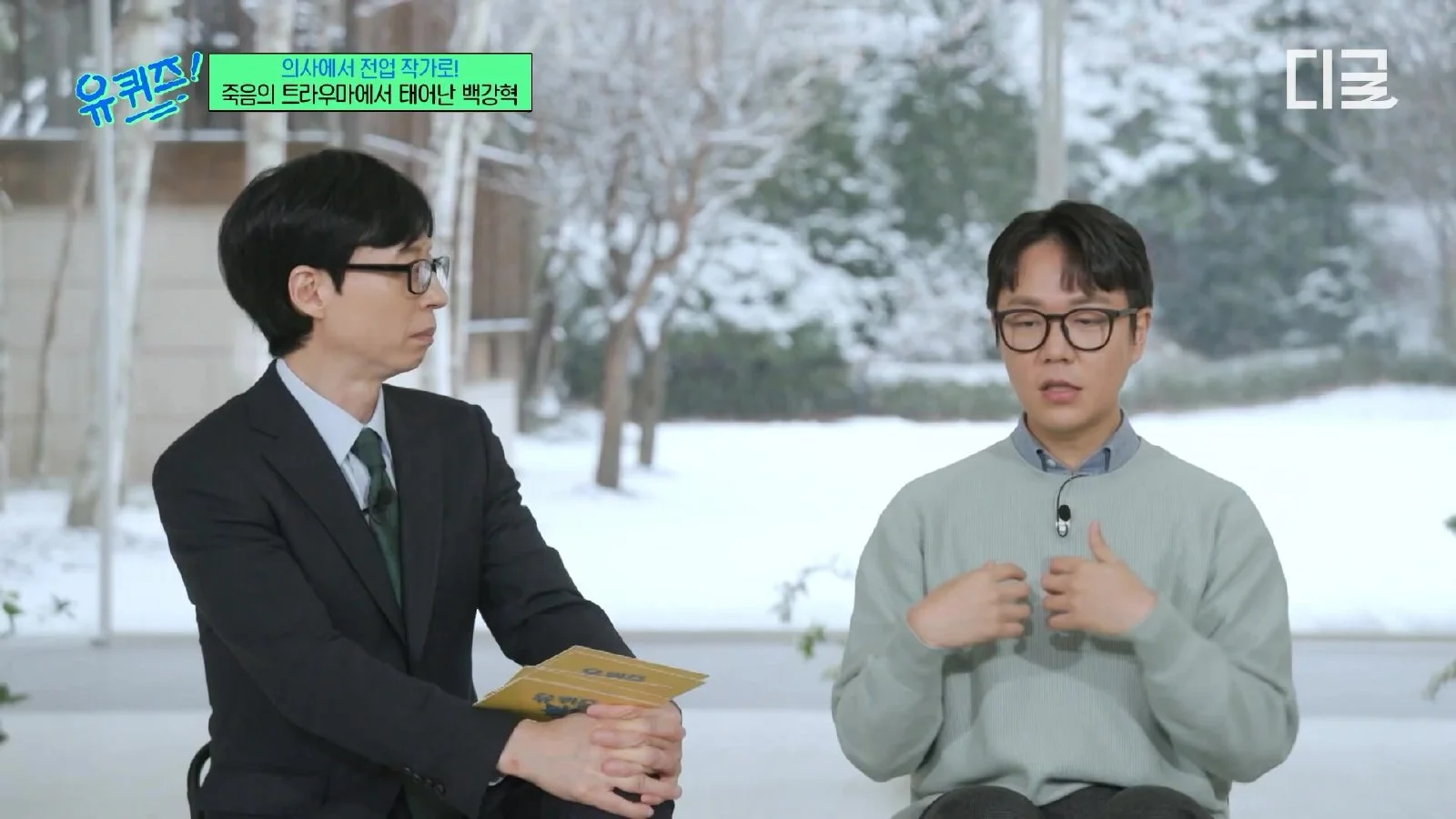
Additionally, an unexpected setting for the protagonist Baek Kang-hyuk was revealed. Lee explained, "Because Baek Kang-hyuk has sensitive senses and hears things others cannot, he is very afraid of paranormal phenomena." Furthermore, regarding the setting where the protagonist possesses assets worth tens of billions of won through stock investment due to his intelligence, he added, "It is a part that reflects my wishes at the time of writing."
The memory of 'Table Death' that made him give up being a doctor
Specific stories also emerged regarding the motivation that led Lee to walk the path of a surgeon and the decisive event that made him give it up. Lee confessed that during his medical school days, he dreamed of becoming a surgeon after watching the drama 'Behind the White Tower', but was deeply shocked when he witnessed a 'Table Death' where a patient died in the operating room during clinical practice. He stated that after the patient died at the scene at that time, seeing the professor sitting leaning against the wall in the darkened operating room, he felt, "Even people who handle vitals for a lifetime are shocked like that when a patient dies, so this is closer to a calling than a job."
These experiences later influenced his world of work. Lee explained that he realized the terror of trauma surgery through experiencing large-scale disasters such as the Seohae Bridge bus crash accident and the Bombardment of Yeonpyeong, and he wanted to use his novel to unravel the legal difficulties and social sense of debt experienced by trauma surgery medical staff who handle patients with a high probability of death.
"Real doctors can't even wash or sleep"
From the perspective of an actual doctor, Lee pointed out the unrealistic parts of existing medical drama settings without hesitation. Mentioning that the actors appearing in the drama 'Life' are excessively handsome, he said, "In reality, doctors are often a mess because they can't even wash or sleep due to being on duty, but the appearance in dramas has a gap with reality."
He also expressed a critical view regarding the romance settings between professors and residents that commonly appear in dramas. Lee emphasized the difference between the poignant emotions that arise from experiencing difficult work together and dramatic fiction, saying, "A romance between a resident and a professor is almost like Stockholm Syndrome." He continued to suggest that typical settings in medical dramas differ from the actual medical field, saying, "The scene where students give warm saline in the operating room—actual hospitals are not that warm a place."

Comments 0