
Shih Tzu Momo, unable to sleep due to fear of inter-floor noise, seeks recovery through soundproof house and aromatherapy
The video explores how to manage a pet's sleep environment and psychological state through the cases of Momo, a Shih Tzu with chronic insomnia caused by noise…
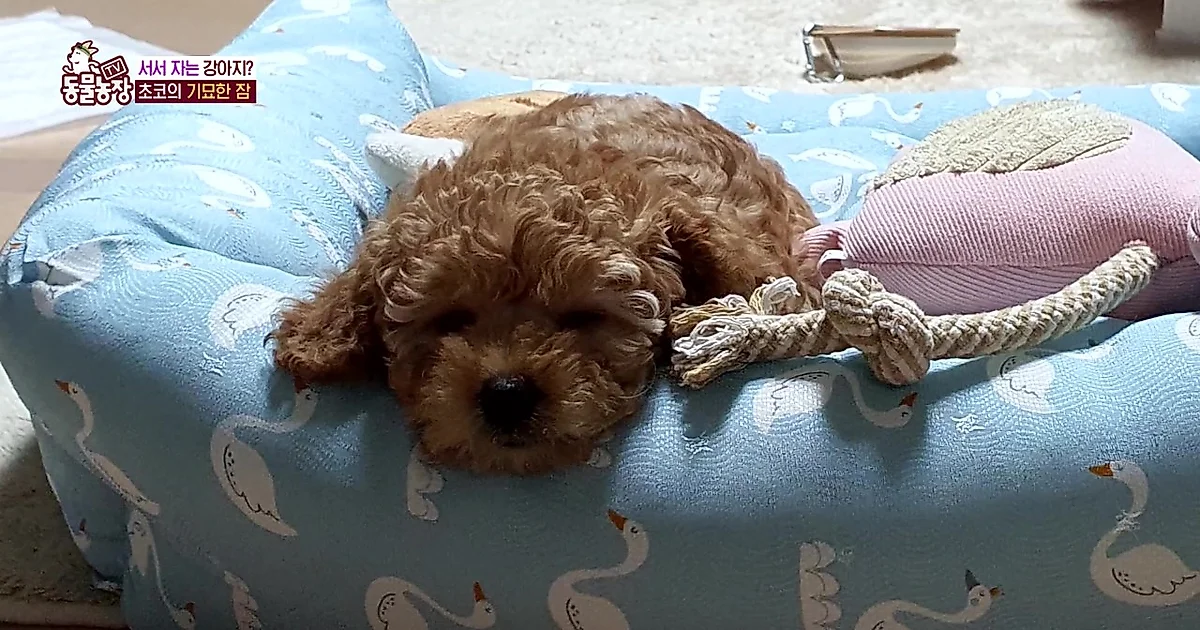
A pet dog's sleep issues can go beyond simple fatigue and be directly linked to psychological anxiety or lifestyle habits. According to a video released on the SBS TV Dongmulnongjang x Animalbwa official YouTube channel, one can learn how to manage a pet's sleep environment and psychological state through the cases of 'Momo', a Shih Tzu suffering from chronic insomnia due to fear of inter-floor noise, and 'Bori', a pet dog who has become lethargic due to excessive sleep.
Chronic insomnia of Shih Tzu Momo, whose fear of inter-floor noise has become ingrained
Six-year-old Shih Tzu Momo has been suffering from severe insomnia for the past two years. In the video, Momo sleeps less than 5 hours a day and is in a state of light sleep, repeatedly waking up and falling back asleep. In particular, Momo reacts extremely sensitively to sounds occurring from the floor above; when sounds are heard, Momo shows panic symptoms such as the tail dropping and the body stiffening. Momo even retreats to the bathroom or screams, unable to overcome the anxiety. In the video, Momo was captured looking dazed with a lowered tail and an awkward posture, reacting to the noise from upstairs.
The cause of these symptoms was not simple noise, but 'inter-floor vibration.' In the video, Director Lee Chan-jong analyzed that Momo feels great fear not from the sound itself, but when the frictional vibration occurring upstairs travels through the ceiling and vibrates the entire house. Although there was more noise when living in a studio apartment in the past, there were no problems, but in the current residence, the vibration has been imprinted as fear, causing a 'fear response' where Momo falls into a state of panic even at small sounds. Lee Chan-jong explained that when Momo is startled by sound, it is not a state of recognizing that it is not dangerous and recovering, but a state where nothing can be thought or accepted due to fear.
To solve this, a 'special house' was prepared for Momo. This house is designed to block external noise by reinforcing the walls and ceiling with sound-absorbing materials. Training was conducted in parallel to help Momo perceive the house as a safe space by searching for treats inside. During the training process, Momo showed signs of finding stability inside the house by focusing on the treats even in situations where external noise was felt. In particular, Momo also showed behavior such as scratching the floor inside the house to mark it as its own space. Additionally, aromatherapy using warm water was used in parallel for muscle relaxation and mental stability. Aromatherapy has the effect of helping lymph and blood circulation with warm water, which induced deep sleep for Momo.
How to solve the lethargy of Bori, who only sleeps due to overprotection
There was also a pet dog with the exact opposite problem from Momo. One-year-old Tommy (Bori) sleeps so much that he falls asleep immediately even when strangers visit. According to the video, Bori is in a lethargic state, spending most of the day sleeping, to the extent that he sleeps for one hour after playing for about 10 minutes. According to the guardian, Bori wakes up between 10:30 AM and 11:00 AM and spends most of the time until evening in a sleep-induced state. This was found to stem from lifestyle habits rather than health problems.
Lee Chan-jong pointed to 'overprotection' as the cause for Bori. Rather than trying to solve something on its own, Bori had formed a habit of immediately requesting help from the guardian when a problem occurred. As the guardian did everything instead, Bori had no opportunity to feel a sense of achievement, which led to decreased activity and excessive sleep. Lee Chan-jong pointed out, "Normal dogs try to solve problem situations, but Bori doesn't even try and just gives up," analyzing that Bori grew up like a flower in a greenhouse and lost the opportunity to feel achievement.
The training conducted to restore Bori's vitality was 'solving it by oneself.' Bori was induced to directly take out a ball that went under the sofa and was given a mission to find a ball hidden under a towel. At first, Bori was someone who quickly gave up and sent an SOS to the family when unable to take out the ball, but after repeated attempts, Bori experienced a sense of achievement by lifting the towel and finding the ball on its own. This successful experience changed Bori's attitude. After the successful mission, Bori showed very active and energetic behavior unlike before, showing positive changes such as eating meals by itself without the guardian's help.
Key points for healthy sleep of pet dogs
The key to pet sleep management that can be learned from these two cases is the harmony between environmental factors and psychological achievement. In the case of a pet dog sensitive to noise, if the noise cannot be completely blocked, it is important to provide an independent safe space where the impact of noise can be minimized using sound-absorbing materials, etc. Through this, a process is needed to make the pet dog perceive a specific space as a 'safe refuge.' In cases like Momo, where noise is imprinted as fear, it is a priority to instill the perception that the space is comfortable through house training.
Additionally, for pet dogs that have excessively low activity or are lethargic and only sleep, appropriate physical activity and brain stimulation are essential. Rather than the guardian solving all problems instead, having the patience to wait so that the pet dog can feel a sense of achievement by solving problems on its own plays a decisive role in increasing the vitality of the pet dog's life. This is because the joy a pet dog feels when it uses its head and body to achieve a result leads to the vitality of life.



Comments 0