
Schizophrenic Patients and Families in the Film 'What Should We Have Done?': Analyzed by a Psychiatrist
Professor Joo Yeon-ho from Asan Medical Center analyzed the psychological states and behaviors of characters in the Japanese documentary film…
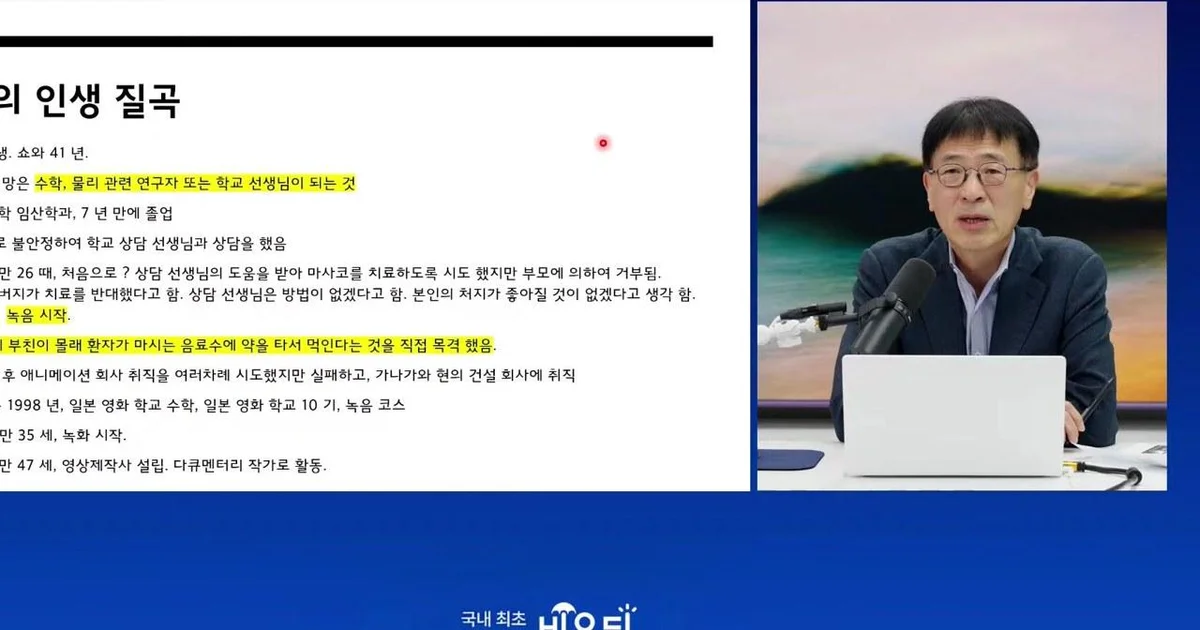
An analysis of the psychological states and behavioral patterns of the characters appearing in the Japanese documentary film 'What Should We Have Done?' from the perspective of a psychiatrist has been released. Professor Joo Yeon-ho of the Department of Psychiatry at Asan Medical Center, appearing on a live broadcast of the medical channel After the Rain, medically explained the conflicts experienced by the protagonists in the film and the coping mechanisms of schizophrenic patients and their families.
Composition of the film 'What Should We Have Done?' and the Director's Intent
Professor Joo Yeon-ho explained that although the film is a documentary, it has a strong poetic nature, selectively showing only the points the director deemed important rather than using a prosaic method to explain the preceding and following circumstances in detail. He analyzed that because of this, there are parts where information is omitted, which may feel bizarre depending on the viewer.
In particular, he noted that the title of the film, 'What Should We Have Done?', is in a form where the subject is omitted. While this could be a question from a general perspective, it is also a question the director himself poses through the film. Professor Joo mentioned that the theme of the film is connected to the issue of how the director himself, who decided to reveal this story to the world, should have acted.
The Onset Process of Patient Masako and the Family's Care Records
Medical inferences regarding the life and the timing of the onset of the character Masako in the film also followed. According to the explanation in the video, Masako showed distinct psychotic symptoms around the age of 24 in 1983, but subsequently lived at home, isolated from psychiatric treatment for 25 years. Based on factors such as Masako believing she had cancer during her high school years, Professor Joo raised the possibility that prodromal symptoms were already present at that time.
The primary caregivers for Masako over the long period were her parents, specifically her mother and younger brother, rather than her father, who performed the role of caregiving. It appeared that the father was working at a university near Tokyo at the time, making it difficult for him to care for the patient directly. Masako was finally hospitalized in a psychiatric hospital at the age of 49 in 2008 to begin antipsychotic medication treatment, and subsequently passed away at the age of 62 after being diagnosed with lung cancer.
The Choice of Father Masahiro and the Final Conversation
The latter part of the film contains a scene where the father, at the age of 96 facing the end of his life, has a private meeting with his son. Professor Joo explained that this scene goes beyond a simple father-son relationship and shows the son conveying his sincerity to the father as a human being who has upheld his beliefs against another human being.
In the video, it was mentioned that regarding the question posed in the film, "What should [he] have done if the father went back to the old days," the father, Masahiro, left an answer to the effect that he does not consider Masako's life a failure. This was presented as a core passage that pierces through the question posed by the film and the lives of the characters.
Comments 0