
Osteoporosis Treatment: Why You Must Not Stop Medication Even After Bone Density Improves
Professor Park Seung-shin of Seoul National University Hospital emphasizes that osteoporosis treatment is a preventive measure to reduce fracture risks rather…
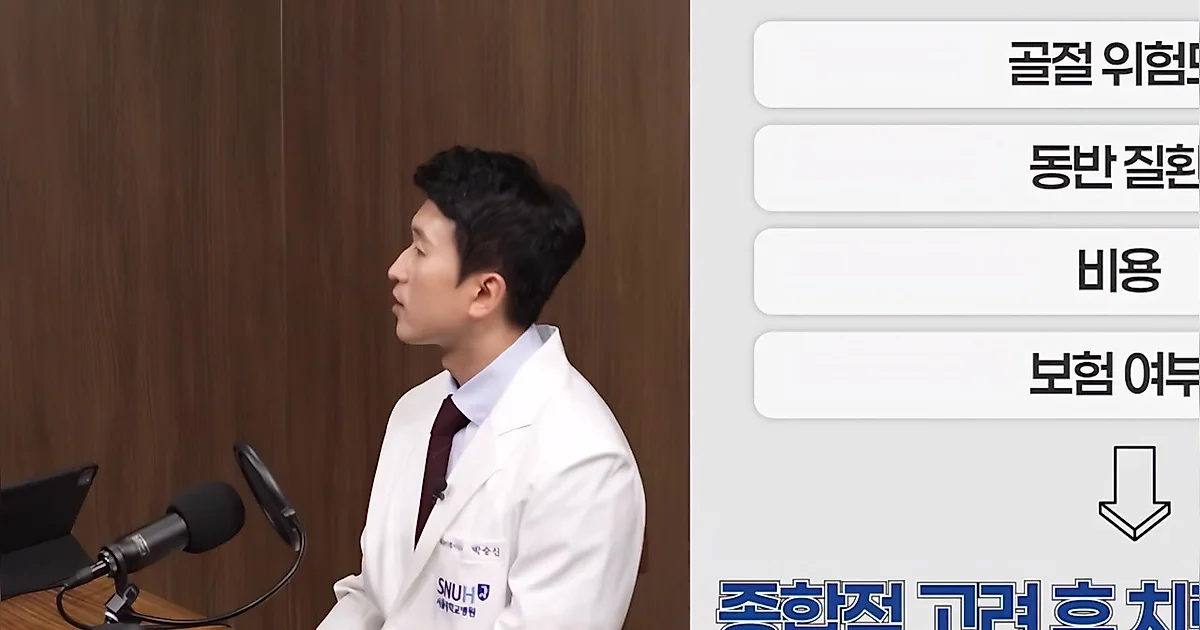
Osteoporosis is easy to neglect because it often lacks pain or specific symptoms, but the core of treatment is not simply increasing bone density numbers, but preventing 'fractures.' Professor Park Seung-shin of the Department of Endocrinology and Metabolism at Seoul National University Hospital emphasized that osteoporosis treatment is not about eliminating current pain, but is a preventive treatment intended to lower the risk of fractures that may occur in the future.
Decisions on drug treatment are not made by T-score alone
The diagnostic criteria for osteoporosis is usually a T-score of -2.5 or lower. However, according to the video, one should not unconditionally delay drug treatment just because the value is higher than -2.5. In the case of patients who have already experienced fractures in the spine or elsewhere, or have experienced a recent fracture, more aggressive treatment may be necessary because the risk of a re-fracture occurring in the near future is very high, regardless of the value.
Lifestyle corrections, such as the intake of calcium or vitamin D, are the most basic management methods. These can be sufficiently consumed through milk, dairy products, tofu, fish, etc., and supplements can be used if there is a deficiency. However, if a patient has already been diagnosed with osteoporosis or has a high risk of fracture, managing these lifestyle habits alone is insufficient, and appropriate drug treatment must be combined to inhibit bone loss and lower the risk of fracture.
Choosing a treatment: Which is better, bone formation stimulants or bone resorption inhibitors?
Osteoporosis treatments are largely divided into two types: 'bone formation stimulants' that help bone synthesis, and 'bone resorption inhibitors' that prevent bone destruction to increase bone density. In the past, it was common to use bone resorption inhibitors first and then switch to bone formation stimulants, but recently, the order of treatment is decided by comprehensively considering the patient's fracture risk, comorbidities, age, kidney function, cost, and insurance coverage.
Depending on the patient's condition, oral medication may be suitable, or if there are gastrointestinal issues, an injectable may be a better choice. In particular, drugs such as Denosumab, which is an injection administered every 6 months, require caution. This is because if such drugs are discontinued or the administration timing is excessively delayed, the efficacy disappears quickly, causing bone density to decrease and the risk of spinal fractures to increase suddenly. Therefore, when stopping medication, a plan to transition to another treatment must be established.
Essential check before dental treatment: Jaw bone necrosis side effects and the meaning of height decrease
Caution is required if you are facing dental treatment such as implants or tooth extractions while using osteoporosis medication. Side effects of jaw bone necrosis have been reported in some bone resorption inhibitors. However, according to the video, the frequency of occurrence at osteoporosis treatment doses is very low, around 0.01% to 0.1%. Medical staff must judge by comparing the risk of side effects with the risk that fractures could endanger life and the benefits of treatment. To this end, if invasive dental treatment is required, one should inform the medical staff of the fact that they are taking osteoporosis medication in advance and adjust the timing of treatment in consultation with them.
Additionally, the phenomenon of height decreasing as one ages should be closely observed. Height may decrease due to thinning discs or changes in posture, but in the case of osteoporosis patients, height may decrease due to spinal compression fractures occurring without them even knowing. Since spinal fractures can occur without severe pain, if an osteoporosis patient's height has decreased by about 3cm, it is recommended to check for fractures through X-rays rather than dismissing it as simple aging.
There is no 'cure' for osteoporosis; the importance of continuous management
Professor Park Seung-shin explains that there is no concept of a 'cure' for osteoporosis. This is because the fact that bone density has improved through treatment is merely a signal that the treatment is being effective, and it does not mean the osteoporosis diagnosis or the risk of fracture has completely disappeared. Therefore, one must not arbitrarily stop medication just because the test results have improved. If the values have improved, the attitude should not be 'I am all cured now, so let's stop the medicine,' but rather, 'Since the treatment is going well, let's consult with the medical staff on how to establish the next treatment strategy.'


Comments 0