
Why You Must Check Tire Inner Sides and Coolant Leak Traces Before Long-Distance Driving During Chuseok
Before embarking on long-distance trips for the Chuseok holiday, drivers should perform detailed vehicle inspections, including checking for uneven tire wear…
If you have long-distance driving planned to your hometown for the Chuseok holiday, checking the detailed condition of your vehicle is as important as changing the engine oil. Rather than simply changing the engine oil and departing, you must meticulously examine the tire wear status, the battery's startup sound, and traces of coolant leaks to prevent the car from stalling on the road during your trip home.
How to Check for Uneven Tire Wear and Battery Startup Sound
According to the Chagaemi video, when inspecting tires, you must check not only the outer surface but also the inner side. Even if the outside of the tire looks fine, if uneven wear has occurred on the inside to the point where the steel wires are visible, the tire could burst during high-speed driving, leading to a major accident. For front wheels, you can check the inner side by turning the steering wheel left and right, while for rear wheels, you must bend down to check for abnormal wear on the inside. Additionally, adjusting the air pressure to the proper level before departure is essential.
The battery status should not be judged simply by whether the engine starts. The video recommends focusing on the "rhythm" of the engine starting. As a battery nears the end of its life, a precursor symptom appears where the rhythm of the engine starting becomes slower than usual. If the starting rhythm has slowed down, a situation where the engine fails to start at a rest area may occur, so inspection before departure is necessary.
Coolant Leak Traces and Brake System Inspection
Checking only the amount of coolant in the reservoir is insufficient. Even if the remaining amount in the coolant reservoir is normal, if there are traces of white, pink, or light green hardened residue around the coolant hoses or the radiator, such as in the cooling system, you should suspect a leak. The video advises that if there are colored white marks on the top of the coolant reservoir or around the hoses, you should immediately receive an inspection at a repair shop. If the water temperature gauge rises sharply during driving, you must be careful as there is a risk of engine overheating, and in such cases, it is very dangerous to hurriedly open the hot radiator cap or reservoir cap.
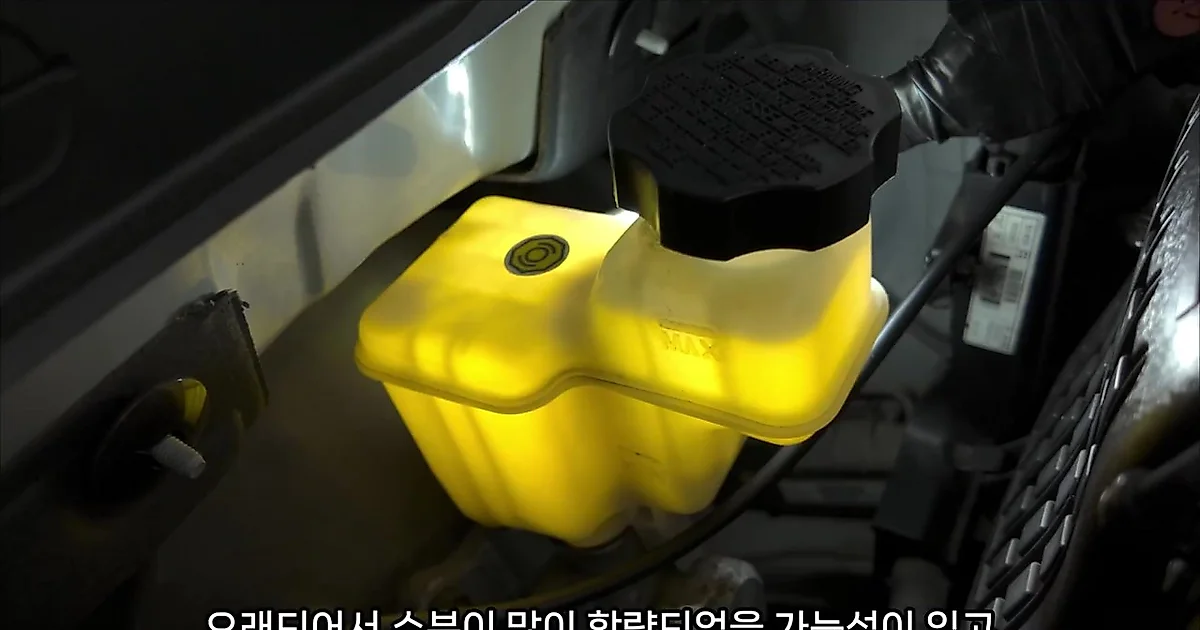
During holidays, since the vehicle becomes heavier than usual due to the weight of passengers and luggage, checking the brakes is also important. You should check the remaining amount (thickness) of the brake pads and visually inspect the discs for cracks. In the case of brake fluid, if the color is dark brown instead of bright yellow, it may contain a lot of moisture, and if the amount is too low, there is a high possibility that pad wear has progressed.
How to Respond When a Red Warning Light Turns On During Driving
If a red warning light comes on the dashboard while driving, you must stop the car immediately. The three warning lights to be careful of are as follows. First, the red oil can-shaped 'oil pressure warning light.' This is a signal that the engine oil pressure is insufficient, so you must stop immediately and check for oil leaks under the vehicle. Second, the thermometer-shaped 'water temperature overheating warning light.' Since the engine is in an overheated state, leaving it unattended could cause the engine to seize. Third, the rectangular box-shaped 'battery charging warning light.' This is not a simple battery problem but a problem with the electrical charging generator system, and it is very dangerous as the engine may stall within 5 to 10 minutes of occurrence.
If a breakdown occurs on a highway, the top priority is for people to evacuate to a safe place before the vehicle. After evacuating past the guardrail to the outside of the road, it may be useful to contact the Korea Expressway Corporation call center (1588-2504) before contacting an insurance company. By using the Korea Expressway Corporation's emergency towing service, broken-down vehicles can be moved to a safe place such as a nearby rest area or a roadside rest area.


Comments 0