
Indoor environments to reduce cat stress: managing lighting, noise, and odors
According to the 'Yoon Sam's My Pet Counseling Center-Pet Clinic' video, cats possess superior senses compared to humans, meaning lighting, noise…
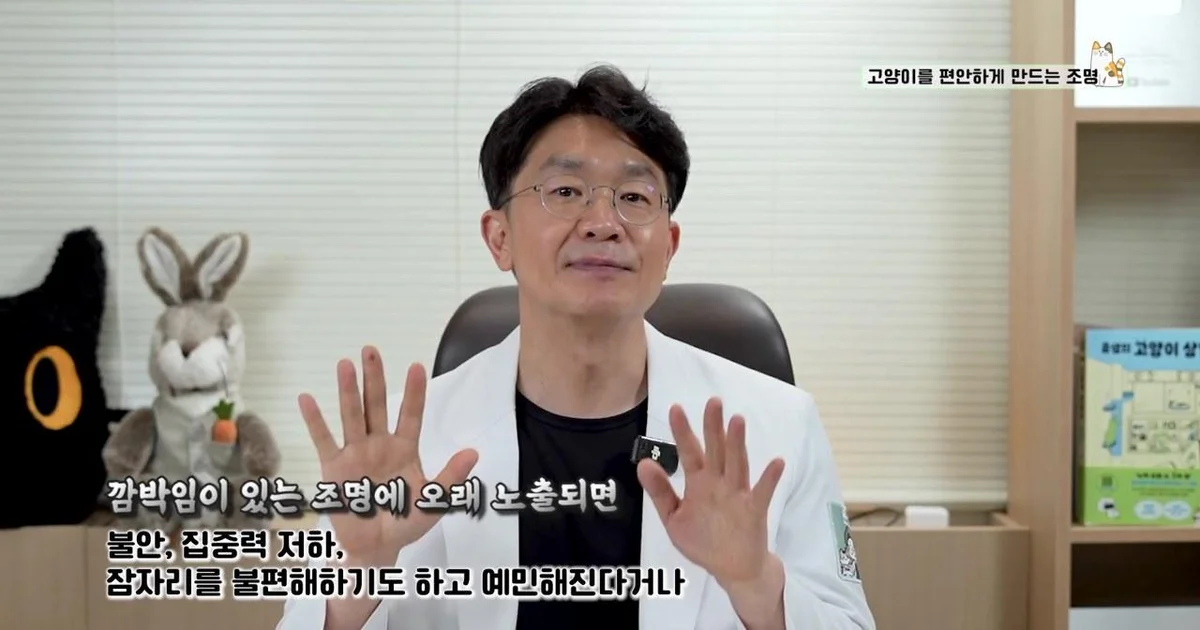
Choosing good food for a cat and playing with them frequently using toys are natural efforts for an owner. However, invisible indoor environmental factors can significantly impact a cat's stress and health. According to the 'Yoon Sam's My Pet Counseling Center-Pet Clinic' video, cats possess senses superior to humans, so managing lighting, noise, and odors is directly linked to their sense of happiness.
Flickering lights and high-frequency noise: discomfort felt by cats
Cats have far superior motion vision than humans. The video explains that cats can sensitively detect 'flickering,' a phenomenon where lights flicker that humans do not perceive. Typical fluorescent lights flicker about 60 times per second, and continuous exposure to such an environment can make cats feel anxious or make their sleeping areas uncomfortable. In severe cases, they may show behavioral changes such as suddenly running around or hiding.
To prevent this, several improvements to the lighting environment are necessary. First, rather than lights that suddenly become bright, a soft and stable brightness should be maintained. Regarding color temperature, a warm yellow range of around 3,000–4,000K is more helpful in lowering a cat's tension than fluorescent lights with strong blue light. In particular, using 'flicker-free LED lighting' that does not flicker is recommended. Additionally, rather than turning off all lights when sleeping, it is better to leave on weak indirect lighting, and natural light coming through windows serves as the best lighting to stabilize a cat's biological rhythm.
Hearing is also a factor that cats react to sensitively. Cats are sensitive to high-frequency noise that humans cannot hear. The sound of a refrigerator motor, the wind noise from a vacuum cleaner or air purifier, the spinning sound of a washing machine, the notification sound of a microwave, and computer fan noise can be continuous background stress for cats. The subtle 'beep' sounds generated by old electronic products disturb a cat's sleep. To reduce this, efforts such as replacing old products or unplugging products that are not in use are necessary.
A space where a cat's natural scent remains instead of artificial fragrances
Smell is one of the most powerful senses a cat possesses. Cats are more than 14 times more sensitive to smell than humans. The video warns that artificial scents, such as scented candles, diffusers, and strong detergent smells, can harm a cat's health or cause great stress. In particular, spray-type cleaning supplies or disinfectant products can be fatal to a cat's health, so it is better to refrain from using them.
The scent environment in which a cat feels most comfortable is a space where artificial scents are minimized and the cat's own scent and the guardian's scent remain appropriately. This is because cats feel a sense of stability in places where their own scent is permeated. Owners must recognize that cats are animals that perceive their surrounding environment in great detail and should create an environment where the cat can stay with peace of mind by controlling lighting, noise, and odors.

Comments 0