
Worried About the Chuseok Charye Table? A Guide to the Order, Precautions and Writing a Jibang
A guide to arranging the five rows of a Korean Chuseok charye table, observing placement rules and preparing a jibang ancestral memorial paper.
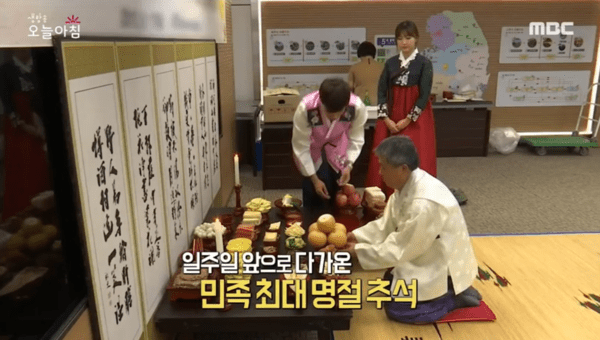
Before discussing the Chuseok charye table, jesa refers to honoring the spirits of one's ancestors by preparing ceremonial food and ritual vessels according to established customs and performing an ancestral rite. A typical table has five rows, arranged as follows. Food placement requires particular care: counting the side where the ancestral spirit tablet is placed as the first row, rice, soup and other meal staples go in that row.
On a Chuseok charye table, grilled dishes, jeon and other main dishes go in the second row. Soups containing ingredients such as fish, tofu or meat, which serve as secondary dishes, are placed in the third row. Side dishes such as seasoned vegetables, kimchi and dried meat or fish go in the fourth row, while fruit, traditional sweets and other desserts are placed in the fifth row.
Rules to observe when arranging a Chuseok charye table include: △ eodongyukseo (fish to the east and meat to the west); △ dudongmiseo (the fish's head to the east and its tail to the west); △ jwapouhye (dried meat or fish at the far left and sikhye at the far right); △ joyurisi (jujubes, chestnuts, pears and dried persimmons in that order from the left); and △ hongdongbaekseo (red fruit to the east and white fruit to the west).
Once the jesa table has been prepared in this way, a spoon is placed with the tteokguk and chopsticks are arranged on the sijeop, a ceremonial utensil vessel, and everyone observes a brief, respectful silence. The spoon is then removed, the lids are replaced, and everyone bows twice. After the jibang and ritual prayer are burned, the table is cleared and the food is shared.
Another important part of preparing a jesa table is knowing how to write a jibang. A jibang is a sheet of paper bearing an ancestor's name that is used during charye or jesa. It is written on white paper measuring 6 centimeters wide by 22 centimeters long. The two upper corners of the paper are slightly trimmed or folded. The characters must be written vertically:
When preparing a jibang for a Chuseok charye table, the inscription is written in the center if one parent has died. If both parents have died, the male ancestor is written on the left and the female ancestor on the right. It is preferable to write the inscription in Chinese characters with a brush, but using a pen is also acceptable, and it can now be written in Hangul as well.FAM타임스 명의로 발행된 기사를 모아 제공하는 매체 공용 저자 페이지입니다.
![[How to Write a Jibang] The ancestral tablet burned after every rite: Is writing only “Hyeongo…](https://img.famtimes.co.kr/famtimes/2026/09/969b1e30-55e6-4e39-b36a-2d952695ebd3-72e50f8d-thumb.webp)
Comments 0