
[How to Write a Jibang] The ancestral tablet burned after every rite: Is writing only “Hyeongo Haksaeng Bugun Sinwi” enough? The proper form
How to prepare and write a traditional Korean jibang, position inscriptions for parents and grandparents, and burn it after ancestral rites.
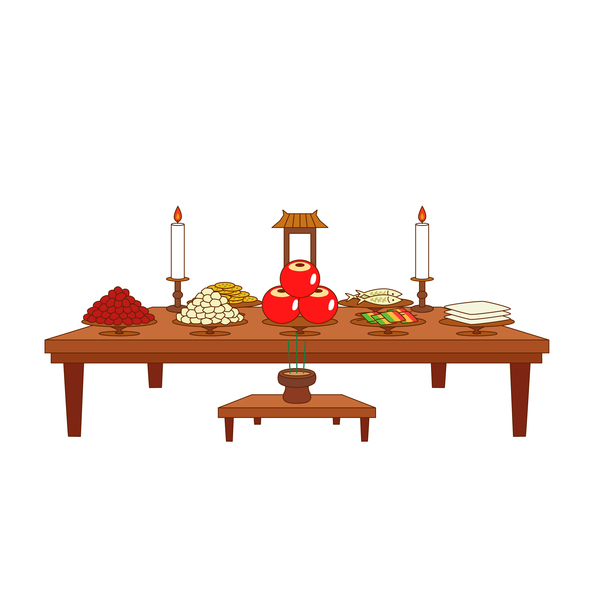
During the major national holidays of Seollal and Chuseok, there is much to learn, from setting the tables for charye and ancestral rites to writing a jibang. The used paper ancestral tablet, or jibang, is customarily burned, so a new one must be written for each holiday every year. Learning how to write one in advance for the busy Seollal holiday can save time when preparing the charye table, including making holiday food.
In principle, a jibang is written in Chinese characters, but these days it is also written in Korean. It can be written simply as “Spirit Tablet of Mother” or “Spirit Tablet of Father,” or as “Hyeongo Haksaeng Bugun Sinwi (顯考學生府君神位).” In this phrase, “hyeongo” indicates the deceased’s relationship to the person presiding over the rite, while “haksaeng” denotes the deceased’s rank. “Bugun” is used when the jibang is for a male, such as a grandfather or father; for a woman, her clan origin and surname are written. “Sinwi” refers to the place reserved for an ancestor who held official rank or the place where an ancestral tablet is enshrined.
A jibang is a temporary ancestral tablet used when there is no permanent tablet, and it may be placed in a holder or frame. First, prepare a blank sheet of paper for the jibang. Jibang paper is generally 22 cm long and 6 cm wide. Cut or fold both upper corners diagonally. The jibang placed on the ritual table represents the spirit of the deceased and is burned immediately after use. The text is written vertically.
When writing a jibang for one’s parents, for a rite honoring the father, “gowi,” using the Chinese character 考 for deceased father, is written on the left. For the mother, “biwi,” using the character 妣 for deceased mother, is written on the right. If only one parent has died, it is written in the center. For grandparents, the grandfather is designated “jogo (祖考)” and the grandmother “jobi (祖位).” In principle, for great-grandparents and earlier generations, the characters “jeung (曾)” and “go (高)” are added at the beginning. Jibang are also used for the samuje and 49-day rites, as well as on Seollal and Chuseok.
FAM타임스 명의로 발행된 기사를 모아 제공하는 매체 공용 저자 페이지입니다.
Comments 0