
Hip Mobility Exercises Needed When Hamstring Shortening Causes Pelvic Tilt
Shortened hamstrings can increase posterior pelvic tilt, causing the lower back to compensate for the hip joint's range of motion.
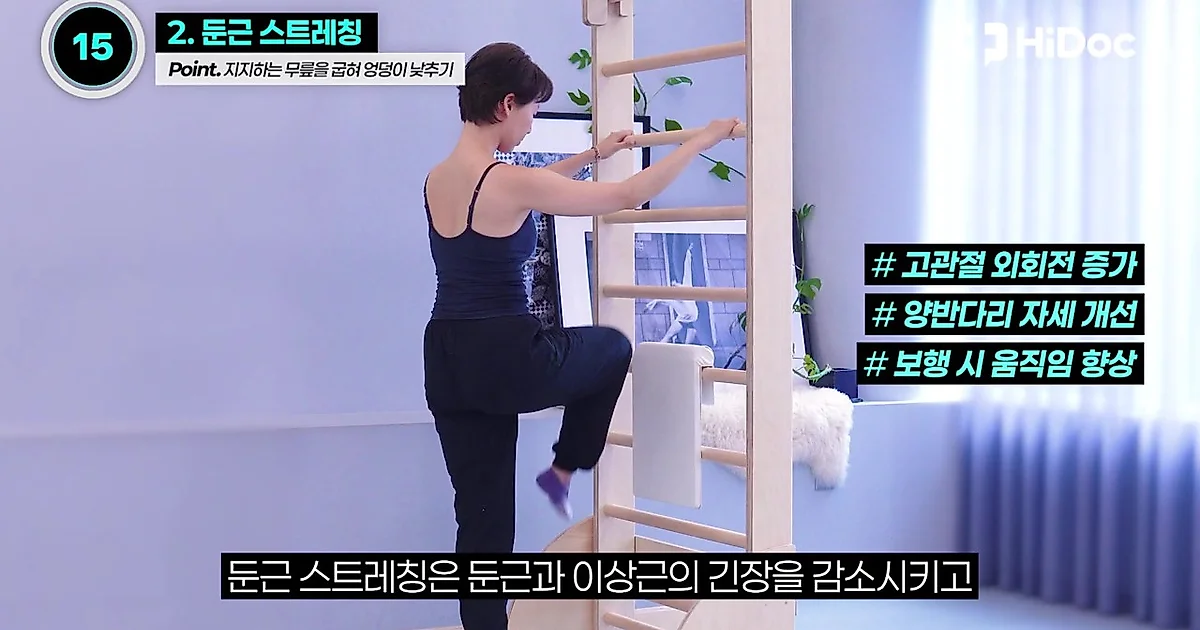
When the hamstrings become short, posterior pelvic tilt increases, and the lower back takes over the range of motion that the hip joint should perform. As a result, if hip mobility decreases, it can lead to restrictions in daily movements such as walking or changing directions. According to a video from the health and medical specialist channel HiDoc, to ensure smooth hip movement, step-by-step stretching is necessary to relieve tension in specific muscles and help the nervous system learn new movements.
Muscle Relaxation Methods to Restore Pelvic Alignment and Rotational Function
The video explains the impact that the condition of the hamstrings, glutes, and rectus femoris has on hip mobility. Relaxing the hamstrings restores pelvic movement and improves hip flexion, creating an environment where the hip joint can move smoothly.
Glute stretching reduces tension in the glutes and piriformis, restoring hip rotational movement. If the glutes are excessively tense, external hip rotation and rotational functions are limited, which can lead to movement restrictions when sitting cross-legged, squatting, or walking. Hip rotational function is key to walking and changing directions.
Additionally, rectus femoris stretching secures hip extension movement and improves pelvic alignment. The rectus femoris is a muscle that extends both the hip joint and the knee; if this muscle shortens, it can cause anterior pelvic tilt and lumbar hyperextension. Therefore, properly relaxing the rectus femoris is important for stable pelvic alignment.
Securing Mobility and Full-Body Integration Through Active Movement
Beyond simple static stretching that merely lengthens muscles, a process of securing the joint's range of motion within actual movement is required. The movements presented in the video focus on increasing the coordination between the nervous system and the muscles.
Unlike static methods, standing hip stretching secures the joint's range of motion through actual movement and helps the nervous system learn new movements. Mobility secured through movement in this way connects to actual function. Similarly, active hamstring movements improve the ability to self-regulate the range of motion. Through this, neuromuscular coordination can be improved, and the ability to control the joints independently can be developed.
Finally, the Downward Dog pose integrates full-body movement by connecting the hips, core, and shoulders. This is because movement is not performed using only specific joints, but is achieved through the connection of the entire body. Downward Dog is a representative integrative exercise that activates the posterior chain and improves full-body coordination, starting from the connectivity of the whole body rather than individual joints.
Comments 0