
Rotator Cuff Tear: Why You Shouldn't Neglect It Just Because the Pain Disappears
Rotator cuff tears are degenerative diseases that can continue to progress even after pain subsides, potentially leading to larger tears if left untreated.
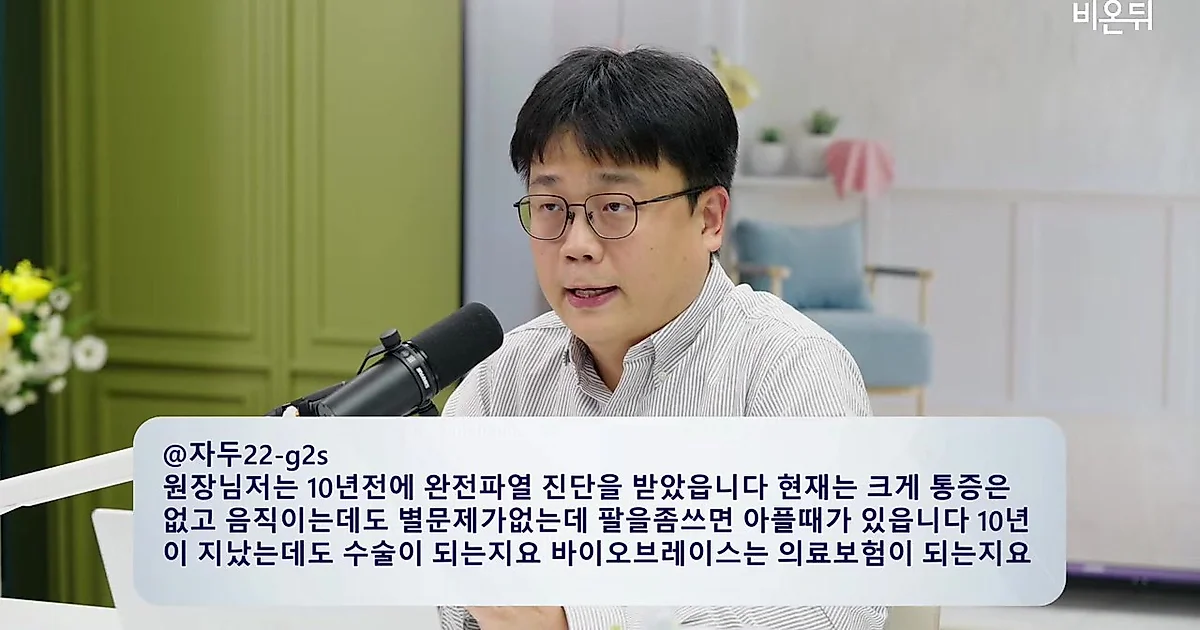
Rotator cuff tear, a representative cause of shoulder pain, is not fully cured simply because the pain disappears. This is because there are situations where surgery is absolutely necessary depending on the degree and location of the tear, as well as whether muscle strength has decreased.
According to a video from Uihak Channel Biondwi, the rotator cuff refers to four muscles that start from the shoulder blade (scapula) and connect to the upper arm bone (humerus). These muscles pass through the space under the acromion of the shoulder, and in this process, they cause friction with the surrounding bones, leading to tears where the tendons become frayed or ripped. It is similar to the principle where a taut rubber band gradually wears down due to repeated friction and eventually snaps.
Tears can continue to progress even without pain
Many patients mistakenly believe that the disease is cured when the pain decreases. However, rotator cuff tears are mostly degenerative diseases that progress slowly. Pain often occurs not because the tendon itself is tearing, but because inflammation generated around the torn area stimulates the nerves. Even if the pain disappears by reducing inflammation through medication or injection therapy, the physical state of the tear remains, and if the arm continues to be used, the range of the tear may gradually widen.
In particular, when the tear progresses to the 'full-thickness tear' stage where a hole forms in the tendon, a phenomenon occurs where the torn tendon is pulled backward. If this condition is neglected, the scope of surgery may increase later or the prognosis may worsen, so it is important to judge the condition through accurate examination regardless of the presence of pain.
Criteria for surgical and non-surgical treatment according to tear thickness
The direction of treatment varies depending on how much of the tendon thickness the tear has encroached upon. The video explains the degree of tear by dividing it into three stages.
- Less than 25% tear: A state where the tear is not severe, and recovery can be expected through non-surgical methods such as injection therapy or medication.
- 25%~50% tear: It is difficult to expect natural recovery. Non-surgical treatment at this stage aims to slow down the speed at which the tear progresses more rapidly.
- Over 50% tear: There is a very high possibility of leading to a full-thickness tear where a hole forms in the tendon, so surgical treatment should be considered.
Even in cases where a re-tear occurs, caution is required even if there is no immediate pain. A re-tear after surgery is a sign that the condition is worsening again, so consulting a specialist to decide on surgery at the appropriate time before it becomes difficult to use the arm in the future will help the prognosis.
Correct exercise methods to help rotator cuff health
When a tear is present, excessive strength training can actually be harmful. The video advises avoiding movements that put excessive pressure on the rotator cuff. For example, lifting or pulling the arm while the back of the hand faces upward or inward can cause friction in the tendon and exacerbate the damage.
Instead, exercises that pull downward while the back of the hand faces outward or looks downward can help strengthen surrounding muscles while reducing the load applied to the rotator cuff. Additionally, lowering muscle tension through stretching is also a good method.

Comments 0