
[Tips for Returning to Farming] Intercropping Green Manure Crops When Growing Waxy Corn
Intercropping waxy corn with legumes supplies nutrients, reduces chemical fertilizer use and cuts weed growth by up to 83.3%.
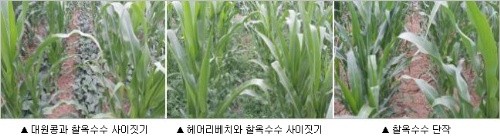
[Pet Newspaper=Reporter Lee Mi-young] The Rural Development Administration said that intercropping waxy corn with leguminous green manure crops and then incorporating them into the soil enables eco-friendly cultivation by supplying nutrients and reducing weed growth.
Corn absorbs large amounts of fertilizer nutrients, so continuously growing it in the same field requires a large quantity of compost to improve soil fertility.
Accordingly, the Rural Development Administration's Cultivation Environment Division developed an “intercropping method using green manure crops” that allows waxy corn to be grown reliably while reducing chemical fertilizer use.
For this green manure intercropping method, legumes such as soybeans, cowpeas and hairy vetch are planted alongside waxy corn during the corn planting season, from late April to mid-May.
Plant soybeans or cowpeas between the rows sown with waxy corn, spacing the hills 15 cm apart and placing three to four seeds in each hill. For hairy vetch, broadcast about 4 kg of seed per 10 ares and cover it with soil.
After the waxy corn is harvested, the green manure crops grown alongside it are incorporated into the soil by plowing the field with a tractor or performing rotary tillage.
When converted to an equivalent amount of nitrogen fertilizer, intercropped hairy vetch provides an effect of about 7.5 kg per 10 ares, Daewon soybeans 5.8 kg and Seowon cowpeas 5.3 kg.
The method also reduces weed growth. Intercropping was found to reduce weed growth by 83.3% with Daewon soybeans, 82.2% with Seowon cowpeas and 51.4% with hairy vetch.
FAM타임스 명의로 발행된 기사를 모아 제공하는 매체 공용 저자 페이지입니다.



Comments 0